
We’ve launched Wealth’s New Look. A campaign focused on speaking with the real people building wealth. Horia and Amina are the first in the series.
So, how did you come across Sarwa?
Horia: I think it was right after the pandemic. I was with a different company, an entirely different scheme. One of those “famous pension plans,” if you want to call them that. They weren’t really pension plans, and they were notorious at the time, particularly around Dubai.
You know those investment schemes where you sign up and then you’re locked in for a period of time? It was one of those.
And then I came across… I think it was a Sarwa ad on Sheikh Zayed Road, on one of the bridges, and it advertised something like “robo-investor.”
It was attractive enough to look into, because their main point was they’re taking out the human element, the emotion out of making decisions, and they have an algorithm. Hence the “robo” part of investing.
Horia: So I said, “Look, whichever way you’re doing it, I’m happy with that.” And the fact that they were different, the fact that it was not the typical investment… the main attraction point was that you wouldn’t be locked in. You get in, you get out, you do whatever you want. That felt more natural.
And there was timing as well. After the pandemic, I always betted (sic) on the fact that the market will (sic) recover. So I said, “Let’s buy and let’s see.”
So I think I made an initial deposit of about $90,000 (as stated). That went well.
Horia: And then we started regular savings together. I kind of got Amina to contribute as well, and things just snowballed from there.
I still have that old account. I’ve never contributed to it, so it stayed at that value. But we kept regularly contributing together into a different account. And then some saving accounts and… yeah. Rest is history, I guess.
Sarwa: You mentioned you were previously into pension funds, and then you made the switch to investing in the stock market. What caused that jump?
Horia: Yeah. So those weren’t working well. It was very obvious to me they were underperforming, and very, very expensive. Even if you’re making a decent amount, they always found a way to take your profit away.
Roughly, you’d have to make maybe 10–12% just to cover the fees, make some decent return, and be happy with it, which was impossible.
I think the best the fund ever did was like 6–7% [return]. Yeah, at best you always had like 3–4% leftover max. Actually, the fund was performing negatively at the time. It was very obvious it wasn’t the right choice.
My dad literally said, ‘If I wanted to live in the desert, I wouldn’t have left my Bedouin family.’ And after years, of course, he himself has said that this is the biggest regret of his life that he didn’t invest in one of the houses. Do you know how much the houses were at that time? 100, 120 thousand. Five-bedroom house. — Amina
For someone who is just starting now, what advice would you give them to make the jump and start investing?
Horia: I would say just give it a go. Consistency, right? Start as soon as possible and be consistent.
It’s discipline over… like obviously if you’re that good you can invest directly, but I think long-term discipline beats that one-time luck you might have.
Again, there are traders out there killing it, I’m sure, but I think the product addresses more passive investors although Sarwa does have active options, right?
But I think it’s more about being steady, being disciplined. Make contributions monthly and keep it going.
Where did you get this investing discipline from? Are there financial influencers or investing books that have guided you?
Horia: Not really. I guess you could call it a hunch in a way. But it doesn’t take a lot of imagination or creativity to realize that if you’re consistent, money will eventually pile up.
Amina: It’s family as well. Family has contributed a lot, I must say. But I guess it’s also just being convinced that the math is there, and it’s simple to add up.
Horia: Like Amina said, family did help in the sense where they show you that, hey, this is actually working. If you have a generation who already started investing, maybe not in the most conventional ways like today, but you see where they are right now because they started back in the day. And we want to do the same thing. We’re not getting younger, and we want to have a life for our daughter.
And there was also trust in Sarwa because Sarwa is regulated which is not the case with more (sic) of the billboard investors you see around.
And being “robo,” you literally have to do nothing. You put the money there, forget about it, keep growing it. That was a main driver for us to invest more and more in Sarwa.
Amina, you mentioned family was a big part of your investing mindset. Do you remember a particular memory that taught you something?
Amina: My mom. I’ll tell you a story. So, my dad used to be a golfer. He used to play golf at Dubai Golf Club and he used to meet Mohammed Alabbar there, because his son also used to play golf.
And Alabbar told him back in the day, I’m talking late 90s, early 2000s, he said to him “I have this project, you may want to invest in it, it’ll be good.”
And I was there, and they were sitting by the pool, I remember it clearly. And my dad was like, “What project?” And he said, “Bring the family, bring your wife,” because he knew that my mom was more [of] the financial expert in the family.
So we went there, and it was Emirates Hills. There were literally two houses there, one model and one actual villa.
The road was so full of greenery I remember, but it was really far, near what we call now Sheikh Zayed Road or near Marina. But there was nothing. Literally nothing. These two houses were in the middle of the sand, with surrounding greenery.
Amina: And my mom was like, “Wow, this is nice. Amazing opportunity. These are like the villas when we travel.”
And my dad is like, “He wants me to buy here? Who’s going to live here? I leave my house there and I come here in the middle of the desert to live? What is this?”
My dad literally said, “If I wanted to live in the desert, I wouldn’t have left my Bedouin family.”
And after years, of course, he himself has said that this is the biggest regret of his life that he didn’t invest in one of the houses.
Do you know how much the houses were at that time? 100, 120 thousand. Five-bedroom house.
Interviewer: Oh wow. Stating the obvious, but that would’ve been a good investment.
Amina: (laughs) Exactly! So that was the story I learned from. And of course, you know, my husband is into investing, and that impacts me as well. But, that was the thing that did it.
So family always teaches you things you should do for your own family too.
It’s a city built for spending. — Amina (on Dubai)
Jumping into lifestyle inflation, living in Dubai, how do you hold back the urge to display wealth by buying more expensive things? How do you manage that?
Horia: (looking at Amina, teasing) Did you hear that? I mean, being a woman, right?
Amina: (laughing) I can’t help it! (To interviewer) He does the same with car parts.
Horia: No, I don’t. No, that’s not true.
Amina: It’s true.
Horia: That’s not true. (Points to Amina) The only spender in the family, sir. (teasing)
The truth is… (laughing) I mean, obviously creatures don’t require a lot— (To Amina) I’m joking! I’m joking.
I’m not joking at the same time, she’s the spender.
Okay so like, show me the actual value. I have no problem paying for good stuff, but I want to see value. I don’t want to see a brand.
One way is asking yourself if it’s really worth it. I know it sounds simpler than it actually is, but you have to.
I’m from Romania, and so I’m coming from a place where we’re aware of how low you can go before it becomes uncomfortable. But I know that I still need to be happy, so it’s a perspective thing.
I don’t need an expensive bag to be happy, or whatever the equivalent is in the world of men.
Horia: I love cars and I could spend endlessly on them, but I know a more expensive car is not going to make me happier. It might make you happy in the moment, but it’s not going to make you happy in the long term.
Amina: What do they say? Cry in a Mercedes, that’s better than crying on a bicycle.
Horia: (laughs) Exactly. But we’re fortunate. We have so much more than we actually need, and yeah, it sounds cliché, but you need your health, you need a roof above your head, and you need some food to go on.
Not having to worry about the roof above your head and where the next meal is coming from is luxury. Not everybody gets it.
And how do we stay on top of it in Dubai, which is your original question, I think it’s always reminding ourselves what is actually necessary and just staying real. Dubai is so tempting, right? There’s always something new.
Amina: It’s a city built for spending.
Horia: Yeah. If you’re reckless, you can spend so much. So reminding yourself of what matters, keeping yourself in check, and keeping each other in check is one good way to stay on top of things.
One theme I’ve heard is it’s important to be aligned as a couple financially. How do you approach being aligned?
Horia: I was about to say, I don’t think we’re in alignment. I think I just have to tell her “you can do this,” or “you can do that,” otherwise it’s going to be bad for us. It’s not much of a dialogue, to be honest, she will spend as much as she can and I hold her back. That’s how it always goes.
Amina: But actually we do have these conversations. We’ve been married for seven years now, and… I’m not the person I was before.
I still spend more than my husband, but not as reckless as I used to be. And now I think about the things that I buy.
For example, if I want to buy a new bag, it will be a certain brand that I know has a high resale value. So in case I need something, I can sell it.
Also I have to think about the insurance now. If I buy a more expensive bag, the insurance goes higher, so there are things that I’m only taking into consideration now.
Before, in my parents’ house, I didn’t care. I just get it because I like it. But now it’s different. I’m more aware of our financial standing.
Horia: I think one of the main topics that has a gap here, and probably what Sarwa could benefit from, is real financial education offered to the customers.
For me, my financial education was because I came from a place where you’re forced to be financially – not savvy – but aware. Unfortunately, I was not financially educated, but if you’re coming from a place like that, if you’re not aware of your finances, you’re just going to starve. It’s as simple as that. There’s no disposable income. There’s no cushion that you can always fall back on if you mess up. So, it teaches you, whether you like it or not.
However, here, it’s not the same. And I’m not talking only about Emiratis, I’m talking about the expats that are having kids here too.
If you’ve been around long enough, you’ll notice that there’s a lot more teenagers, a lot more children than there used to be 10 years ago. People our age, maybe 40s to early 50s, these people moved here decades ago, started families, had kids who are here now.
These kids, unfortunately, grow up in a world where there is more disposable income than in other places. That lack of financial “awareness” is what makes the difference, and there’s a severe gap.
I was educated by my own surroundings and environments, but these new generations have no clue. We live the good life, so they live a good life, what’s bad? So for them it’s normal to say, well, if I earn 15,000 dirhams a month, it’s okay for me to own a car with a monthly payment of five, six, even seven thousand dirhams. In no way, shape, or form is that acceptable because you cannot actually afford that. But to them, it’s such a normal thing, and that’s concerning.
These kids grow up in a world where there is more disposable income than in other places. That lack of financial ‘awareness’ is what makes the difference, and there’s a severe gap. — Horia
You’re bringing up something important, which is the question of how we instill financial awareness in younger generations across this country and region. How do you approach imparting financial literacy to your daughter?
Amina: That’s a good question. We got her a cash deposit machine. So when the Sarwa team came to take photos, she wanted to show them because we told her, “You know, these are the people who help us with our money.” She’s five years old.
So we wanted to make sure she gets it, and why they’re coming to take pictures of us. And she took it and showed them and said, “Look, look at my small bank! I keep my money here.”
So yeah, we’re starting slowly.
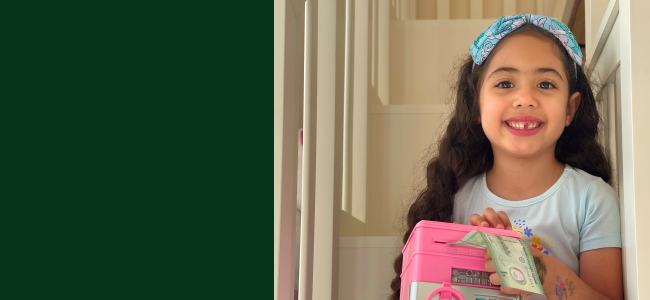
Our family, like my mother or my sister, sometimes his mom also, they give her [cash]. I want her to learn this means something, and she better keep it rather than buy something with them so she doesn’t end up like her mom. (laughs at herself)
Horia: I want her to be conscious about money. But it’s also about teaching values. There’s only so much you can force someone to do.
We want her to understand that happiness doesn’t come from having more money. Don’t get me wrong, having money is fantastic. It solves a bunch of issues, but at the same time it creates unique challenges as well. Stress, anxiety, whatever.
Values means… you can only prepare a kid that much, you know? The values come in when you ask “hey, do you actually need X, Y, or Z? Or maybe it’s better to spend on these other things you actually need?” It’s about learning the difference between what matters and what doesn’t matter. That’s how financial literacy can be taught. It’s a package. It’s not just financial literacy, it’s good values in life that naturally turn into financial literacy: curiosity, understanding, and so on. It’s all of these things. There’s no one silver bullet you can shoot to fix something, right? Every stage needs a different approach. Kids don’t understand money. Teenagers want to show off. People in their 20s and 30s need different explanations, like managing expenses.
But values are the same. That’s where you start. Instilling values, understanding why you’re doing what you’re doing, understanding the big picture.
It’s different when you become a parent. Because first of all, you discover the needs of your child and the future needs of your child. School, university, health care, a lot of things you wouldn’t think about as a non-parent. — Amina
Has your relationship to money changed after becoming a parent?
Amina: Oh, it changed a great deal for me.
Horia: It did change a great deal for Amina. For me, no. I came here… as an expert (joking). No, but I lived alone for quite a while, living off a salary with no support. Once I got married and had kids, I was more comfortable than before.
Whereas for her…
Amina: Of course, for me, it was the opposite. We come from different worlds. So I was, you know, living the comfortable life, I only thought about myself, right? It’s different when you become a parent. Because first of all, you discover the needs of your child and the future needs of your child. School, university, health care, a lot of things you wouldn’t think about as a non-parent.
And when they’re that small, you also have to count yourself with them. Like if I’m putting something aside for my daughter’s entertainment, I’m not just buying her ticket. I need to be there.
It instills… a grand plan. And you also don’t want to keep your child from enjoying life because you’re saving for the future. There’s a balance.
Yeah, it changed a great deal for me, and it’s for the better.
Speaking of grand plans, what does being financially free or independent mean to you?
Horia: We don’t have to work another day, I believe. We travel whenever we want, we own property so you don’t worry about living somewhere. That’s it.
Amina: Yeah. And having a big wardrobe. (cheeky)
Horia: (laughs) I don’t disagree. However… I don’t think it’s actually possible to be totally free, because regardless of your status, there’s always going to be concerns or anxiety or stress. It’s just different concerns at a different level.
To me, financial independence is when you no longer have to do something for income. You do whatever you like because you like it.
I don’t think I’ll ever stop working. It’s just that I’ll do whatever I want, because income no longer decides my day-to-day life.
What advice do you have for younger people on maintaining financial discipline?
Horia: At the risk of never being listened to, start as early as possible. If you don’t believe me, do simple math. Yeah, it’s cliché, everybody’s done it, but if you had $10 a month since the day you were born, that’s invaluable compared to starting at 30 or 40.
Get into the habit. Save money.
Amina: Invest, invest, invest!
Horia: Yeah, of course. Invest money. You don’t have to be aggressive. Discipline beats risk.
Don’t live outside your means. You’re young. At the same time, enjoy your life. There’s no need to save everything.
If you start early, what seems pointless actually lets you enjoy life better because you know you’re doing something for your future.
And anxiety comes from not knowing what’s going to happen. If you have a plan, if you’re lucky enough to find someone to advise you, eliminate as many variables as you can.
There are people too reckless with money, and people too worried about money. Something in between. Both benefit from starting early and being diligent.
And today, being 20 today looks extremely difficult. If I were 20 today and looking at the market, it feels impossible to ever own property. So, yeah. Start early. Invest. That’s what I’d advise.
Interviewer: I like that you said discipline beats risk.
Horia: Yeah, I mean, look if there’s something that defines humans, it’s greed. Greed isn’t bad, but it can be destructive. Greed keeps you going, makes you hungry. It’s ambition. And greed is ambition, but too much ambition becomes greed.
If you can overcome that and be disciplined… that’s the key. At least for now.
Final thoughts
Horia and Amina’s story is just one version of how wealth is being built today. It’s shaped by discipline, family influence, and a clear-eyed view of what matters, especially in a place where it’s easy to lose perspective. In the conversations that follow in this series, you’ll hear different paths, different priorities, and different starting points.
But the same question will keep coming up: what does wealth really look like now?