Estimated reading time: 5 minutes
The most painful part of an investment scam is not always the money lost. It is the moment after, when someone scrolls back through the messages, rereads the promises, notices the pressure, sees the signs they missed, and asks:
How did I not see it?
That question is especially painful with modern pump-and-dump schemes because parts of the scam can look legitimate: the company, the ticker, the chart and even some of the gains.
What is fake is the story built around it.
That is what makes these schemes so dangerous. They do not always start with an obvious request to send money to a strange wallet or unfamiliar account. Increasingly, they begin with something ordinary: an Instagram ad, a Telegram group, a WhatsApp chat, or a private “market education” community led by people who appear experienced.
[Suggested: How to Manage Financial Stress: A Guide]
What is a pump-and-dump?
A pump-and-dump is a market manipulation scheme. Fraudsters accumulate shares in a low-priced and/or thinly traded stock, promote a persuasive story to attract new buyers, then sell into the demand they helped create. Once the promoters exit, the price collapses, leaving later investors with heavy losses.
A fake “market expert” can boast a polished profile, professional language, staged testimonials, and even AI-enhanced content that makes the persona feel more credible than it is. FINRA says it has seen a significant spike in investor complaints since fall 2023 involving fraudulent social-media “investment groups,” many of which move investors into encrypted chats such as WhatsApp or Telegram. The FBI has warned that complaints referencing “ramp-and-dump” stock fraud were up at least 300% in 2025 compared with 2024.
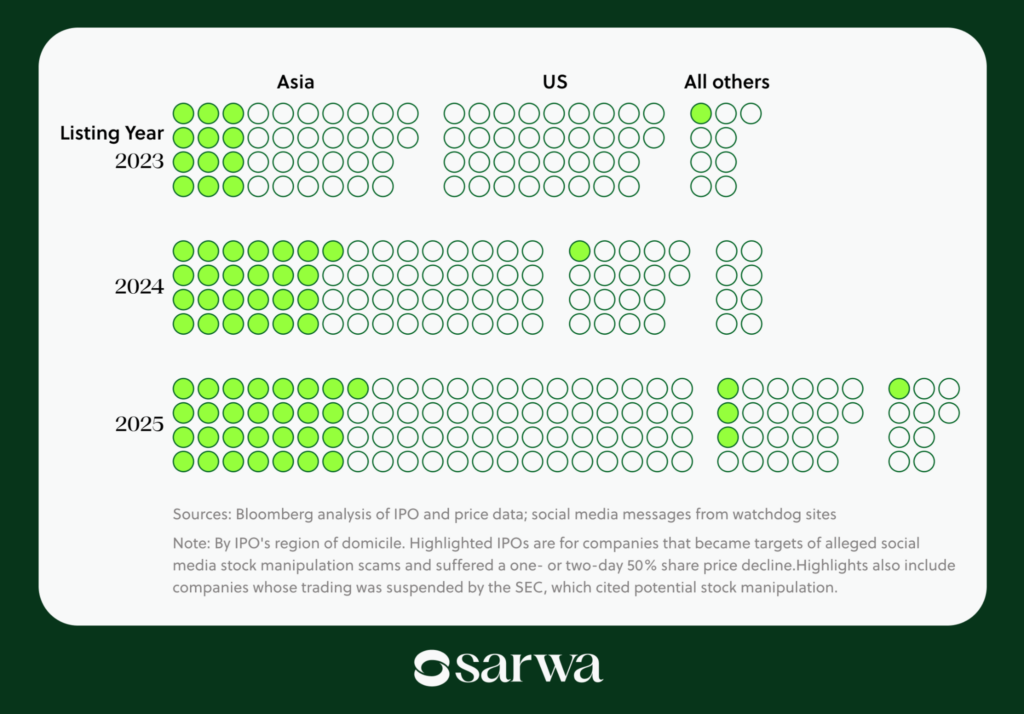
Bloomberg has also recently reported apparent pump-and-dump patterns involving ~60 newly Nasdaq-listed firms, with $16 billion in value erased in one or two sessions.
Most schemes follow a similar playbook:
Build. Sustain. Ramp. Dump.
1. Build: Laying the Tracks
At the beginning, the pitch takes the form of education or soft advice.
A message invites you to join a group; an ad offers free stock insights; or a friendly assistant says a respected strategist is sharing research with a small number of investors. You enter the group and see what looks like a regular conversation. Nothing out of the ordinary… and that is the point.
The first thing being sold is a feeling that you are privy to insights that the market does not know. Remember rule #1 of fight club? Shhhh.
The environment feels legitimate enough that you keep reading and, ultimately, stay.
2. Sustain: The Group Manufactures Belief
Inside the group, belief and credibility are performed in public, almost like a stage play. Mundane back and forth with an occasional update from the “expert”. People share screenshots to show 10/20/30% gains, while others say they are adding on to the position.
All this starts to feel like a community, and communities can create comfort. This is manufactured social proof. Group members can be accomplices, bots, or other victims under the same pressure. This is why warnings around investment-group scams often focus not only on the “expert,” but also on the supporting cast around them.
3. Ramp: The Rise Before the Storm
This is where many investors lower their guard, one of the more uncomfortable parts of the scam.
Because they place the trade themselves, trade decisions feel independent, even when the environment was carefully engineered.
Then the group shifts from education to coordination.
The expert names the opportunity, while assistants repeat the instructions. Meanwhile, members claim they are buying, sharing screenshots as proof and adding to the pressure.
Investors may be asked to share screenshots to confirm how much they bought. It may be framed as support: “We can help analyse your position” or “We want to help you maximise profits.” But it also serves another purpose: giving promoters a clearer sense of who is buying, how much, and at what price.
4. Dump: It All Comes Crashing Down
Then the story breaks.
The stock is crashing, the group goes quiet and the expert urges members to hold or wait for an announcement.
But the market has already moved.
The group was never there to support opportunistic buyers. It’s meant to turn them into exit liquidity for the scammer.
The exact situation doesn’t repeat, but it surely rhymes.
- A thinly traded stock rises sharply.
- A story spreads through private channels.
- New buyers arrive late.
- Promoters exit.
- The price collapses.
- Those left behind deal with the aftermath.
After the collapse, many people blame themselves. They replay the messages and notice what now seems obvious.
Shame helps scammers because it turns a coordinated pattern into a private embarrassment. The better response is to identify the patterns.
Because once you understand the sequence, you are more likely to call the bluff.
An exchange traded stock does not warrant credibility by default. FINRA makes this point clearly. Even exchange listing standards do not guarantee that low-priced stocks trading on exchanges are safe investments. Smaller stocks can have limited public information and may be easier targets for manipulation, especially when their public float is small.
Before acting on any investment idea, especially one that feels urgent, exclusive, or unusually profitable, ask:
Who is behind the idea?
Can I verify the person, platform, or source independently, outside of what they have sent me?

What exactly am I being asked to believe?
Is there independent evidence behind the story, or am I relying on screenshots, testimonials, confident language, or price movement alone?

What can go wrong?
Is the downside clearly explained, including liquidity risk, volatility, concentration risk, and the possibility that the price can fall quickly?

Who benefits if I act now?
Am I really making an independent decision, or could I be helping someone else sell, earn a fee, build hype, or exit a position?

Can this survive a pause?
What happens if I wait, ask questions, verify the facts, or get a second opinion?