A few years ago, the idea of using artificial intelligence to trade stocks sounded like something far beyond the reach of retail investors.
Today, AI-powered investing and trading tools are available to almost anyone with an internet connection. And UAE traders and investors are not left out.
Whether you are conducting fundamental, technical, or sentiment analysis, forecasting price movements, evaluating your portfolio, or creating algorithms to execute your trading strategy while you sleep, there are AI tools that can make your life easier.
In this guide, we’ll help you get started with AI stock trading by explaining how AI is used in stock trading, exploring the best AI-powered platforms for UAE investors, and discussing reasons to be cautious when using AI to trade stocks.
We’ll cover:
- Using AI to trade stocks: The research stage
- Using AI to trade stocks: The execution stage
- Using AI to trade stocks: The evaluation stage
- How to wisely approach AI stock trading
Do you want to learn more about how AI is transforming investing? Subscribe today to Sarwa’s Fully Invested newsletter for regular expert insights.
1. Using AI to trade stocks: The research stage
Three types of analysis are crucial when you are researching stocks to buy: fundamental, technical, and sentiment analysis.
We’ll consider how AI-powered tools can help you with each of them:
Using AI for fundamental analysis
Fundamental analysis is all about assessing a company’s financial health, business model, and market position to determine if it’s a good buy. For value investors, it is also about determining a company’s intrinsic value to determine if it’s currently undervalued, accurately valued, or overvalued.
Though fundamental analysis is more popular with investors, some traders also use it. This is because they prefer to trade stocks of companies that are stable enough to generate consistent trading opportunities.
So, how can you use AI to conduct fundamental analysis:
- Use generative AI to create a comprehensive analysis of selected stocks: Generative AI platforms like ChatGPT, Claude, Gemini, and Perplexity, among others, can act as your equity researcher when conducting fundamental analysis. It’s all about providing them with the right prompts.
Below is a sample prompt for fundamental analysis that you can employ:
“You are an equity researcher with 20 years of experience working for a mutual fund. A portfolio manager in your company is considering buying Ondas Inc. Provide a fundamental analysis of this stock that covers its financial health, competitive position, business model, projected growth, and the prospects of its industry, given projected macroeconomic trends. Also, create a valuation of the company based on relevant multiples and the DCF model (use appropriate assumptions throughout).”
With a thorough prompt like this, you can get a comprehensive analysis that can serve as the foundation of your research.
A potentially better approach is to download the company’s 10K/10Q SEC filings and upload them to the LLM. With this, the LLM has relevant, updated, and accurate information to perform sound equity research.
Below is an adjusted prompt:
“You are a financial analyst specializing in equity research. Using the uploaded 10‑K and 10‑Q filings of Ondas Holdings Inc. (NASDAQ: ONDS), perform a comprehensive fundamental analysis that includes business overview, financial performance, risk factors, competitive position, management discussion, and relevant inputs for a DCF model and valuation multiples. Also, conclude with a balanced investment thesis that highlights strengths, weaknesses, and potential catalysts.”
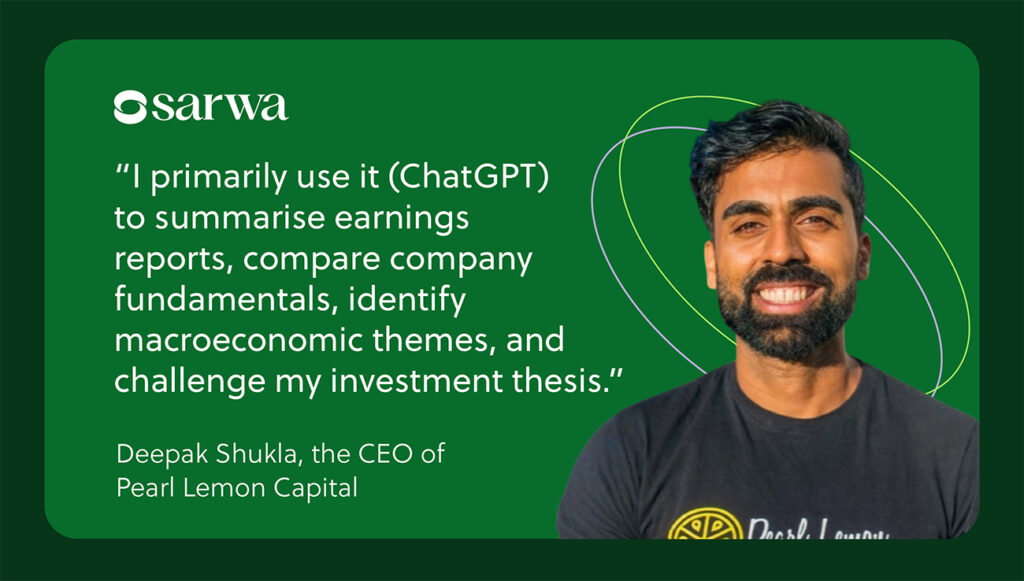
This is similar to how Deepak Shukla, the CEO of Pearl Lemon Capital, a business and property financing company, uses ChatGPT:
“I primarily use it (ChatGPT) to summarise earnings reports, compare company fundamentals, identify macroeconomic themes, and challenge my investment thesis by asking it to present the strongest bear case against a position.”
Another approach is to ask LLMs to conduct this analysis based on the investing model and practices of some of the best investors in the world (think Warren Buffett, Ray Dalio, Michael Burry, Bill Ackman, among others). Below is a sample prompt:
“I am thinking of buying some shares of Microsoft. Perform a fundamental analysis of this stock as if you were Warren Buffett. Use everything we know about Buffett’s investing style and principles. Do you consider this stock undervalued or overvalued based on Buffett’s approach to value investing?”
- Access alternative market data with a tool like FinBrain: FinBrain is an AI-powered financial intelligence platform that provides alternative data sets like congressional trades, corporate lobbying, government contracts, insider trades, and patent filings.
These alternative data can provide more useful information about the growth prospects of the company of interest.
- Use AI-powered stock screeners to narrow potential investment opportunities: If you already know what you are looking for, you can use stock screeners to narrow down the number of stocks you will be doing a deep dive into.
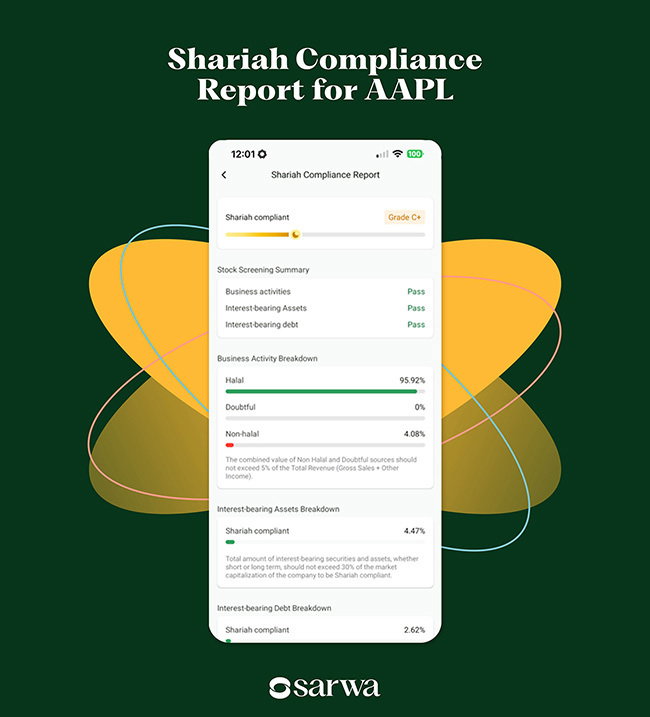
For example, if you are a halal investor, you can use a platform like Sarwa to identify stocks that are Sharia-compliant based on the standards provided by the Accounting and Auditing Organization for Islamic Financial Institutions (AAOIFI).
Below is a sample Sharia Compliance report for AAPL:
For a broader screening based on popular features like dividends, market cap, sector, revenue growth, EPS, among other fundamental factors, TradingView is a popular option to consider.
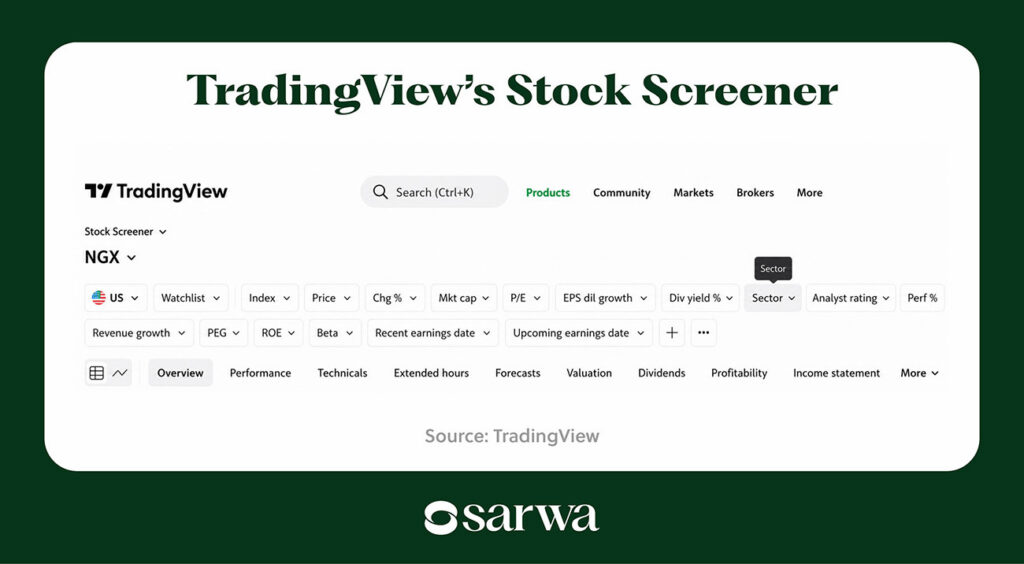
Source: TradingView
If your screening also includes technical factors like candlestick patterns, moving averages, and indicators, then no one does it like FinViz.
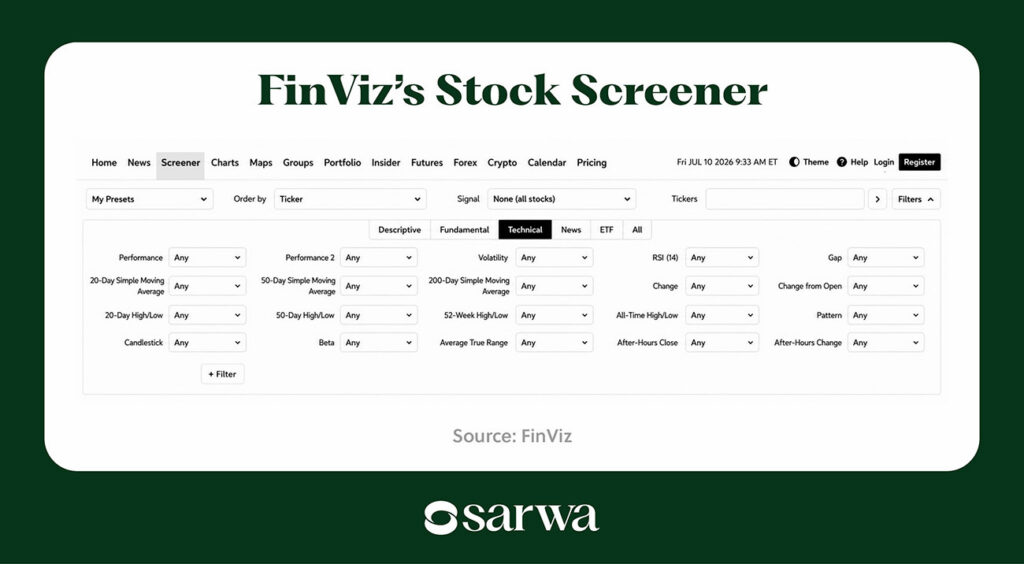
Source: FinViz
SNACS.Trade is another powerful AI screener. It includes many factors that traditional screeners like TradingView and FinViz do not: SEC filings status, velocity, cash runway, short sale restriction status, dilution events, and halt status.
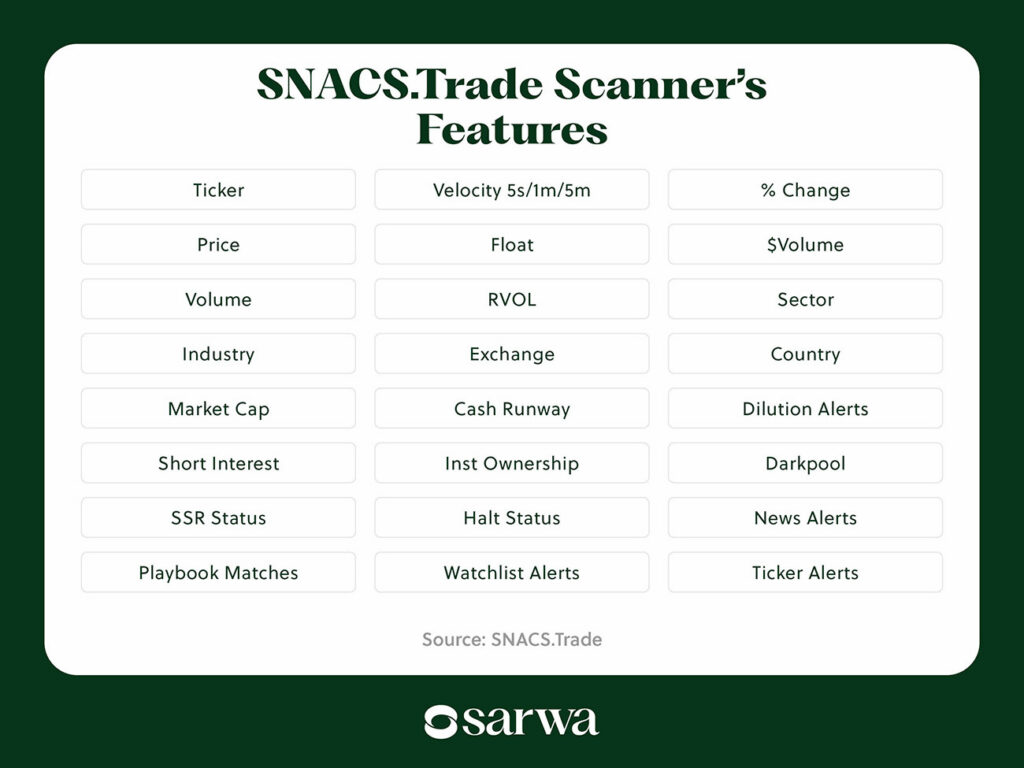
Source: SNACS.Trade
Using AI for technical analysis
Technical analysis is all about designing the right trading strategy. Such a strategy will have precise entry and exit points and risk management protocols (defined stop loss and position sizing).
Even if you are an investor, technical analysis can be a crucial part of using AI to invest in stocks since it can help increase your returns by picking the right time to buy.
Below are some ways AI-powered tools can help with technical analysis:
- Use automatic chart pattern recognition on TradingView and TrendSpider: TradingView remains one of the most popular technical analysis platforms in the world. Its Auto Chart Patterns tool can help you spot different chart patterns without having to draw the lines. This can save you a lot of time and effort while you concentrate on interpreting the patterns.
TrendSpider also has a similar tool.
- Explore AI trading signals with Holly AI and Investing.com: Holly AI is a trading assistant from Trade Ideas that provides between five and twenty-five trading signals every day. These signals include entry points, take-profit levels, and stop-profit levels.
Investing.com also provides comprehensive technical data points that can help you identify opportunities in various markets.
- Use AI-powered indicators: TradingView also provides AI-powered community indicators and machine learning scripts that can help you improve your technical analysis.
Using AI for sentiment analysis
Sentiment analysis is all about gauging market mood. It involves analyzing various information sources (news, social media conversations, analysts’ ratings, earnings calls, and articles) to determine if investors and traders are bearish or bullish about a stock or an entire industry (sector).
Experienced traders use it to predict market movements, identify market overreaction, and prepare for possible market reversals.
Below are some AI-powered tools that can help with sentiment analysis:
- Understand the sentiment behind market news with IUX24: IUX24 is a financial intelligence platform that seeks to provide access to institution-grade analysis to retail traders and investors.
With this tool, you can better understand market news and also connect it to the specific assets and sectors they will affect. For example, after reading this news about the US drone delivery market, you can see how it affects market sentiment for stocks like Walmart, Amazon, and Alphabet, among others.
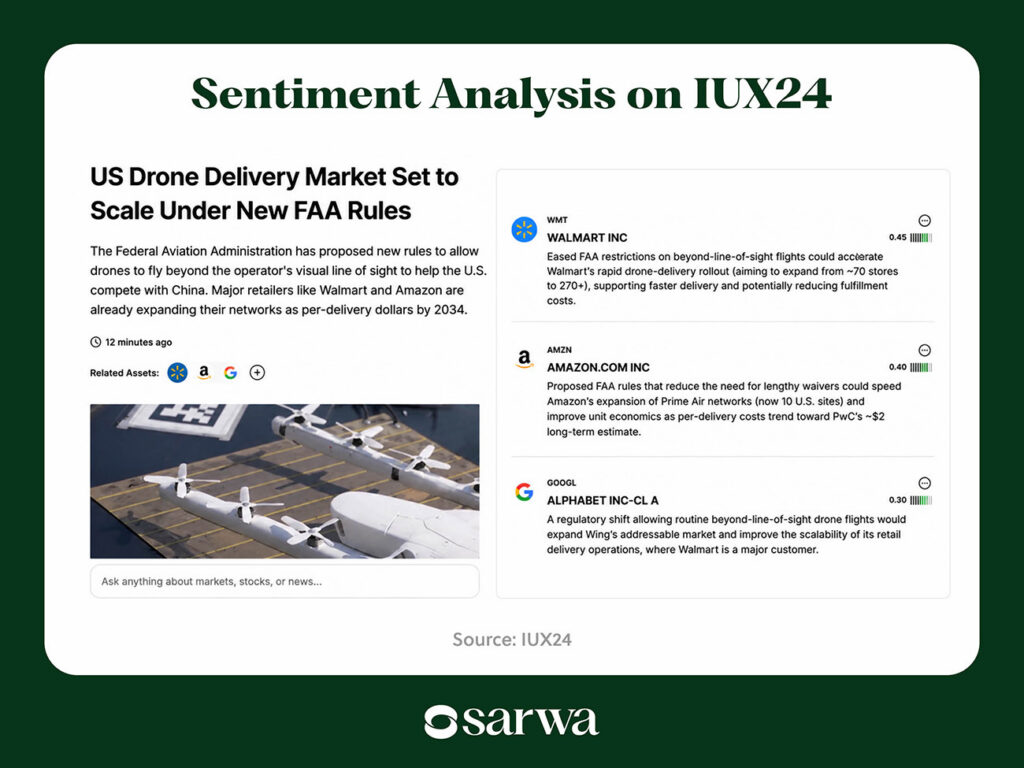
Source: IUX24
- Identify market sentiment from earnings transcripts with FactSet: With FactSet and AlphaSense, you can identify market sentiment through the transcripts of companies’ earnings calls. They will provide the main insights from these transcripts, so you don’t have to read them all.
- Identify market sentiment from social media conversations with StockGeist: A platform like StockGeist pulls social media conversations about publicly traded companies to give you a gauge of the market mood in relation to their stocks.
2. Using AI to trade stocks: The execution stage
After learning how to use AI for stock analysis, the next step is to explore AI trading.
In this section, we focus on AI trading software that can help you automate your trading strategies.
Below are some of the popular ones:
- Expert Advisor on MetaTrader 5: This is a trading robot available on the MetaTrader 5 platform. It automatically executes trades based on its programmed criteria. You can set the lot size, entry conditions, and timeframes or use existing configurations from MT5.
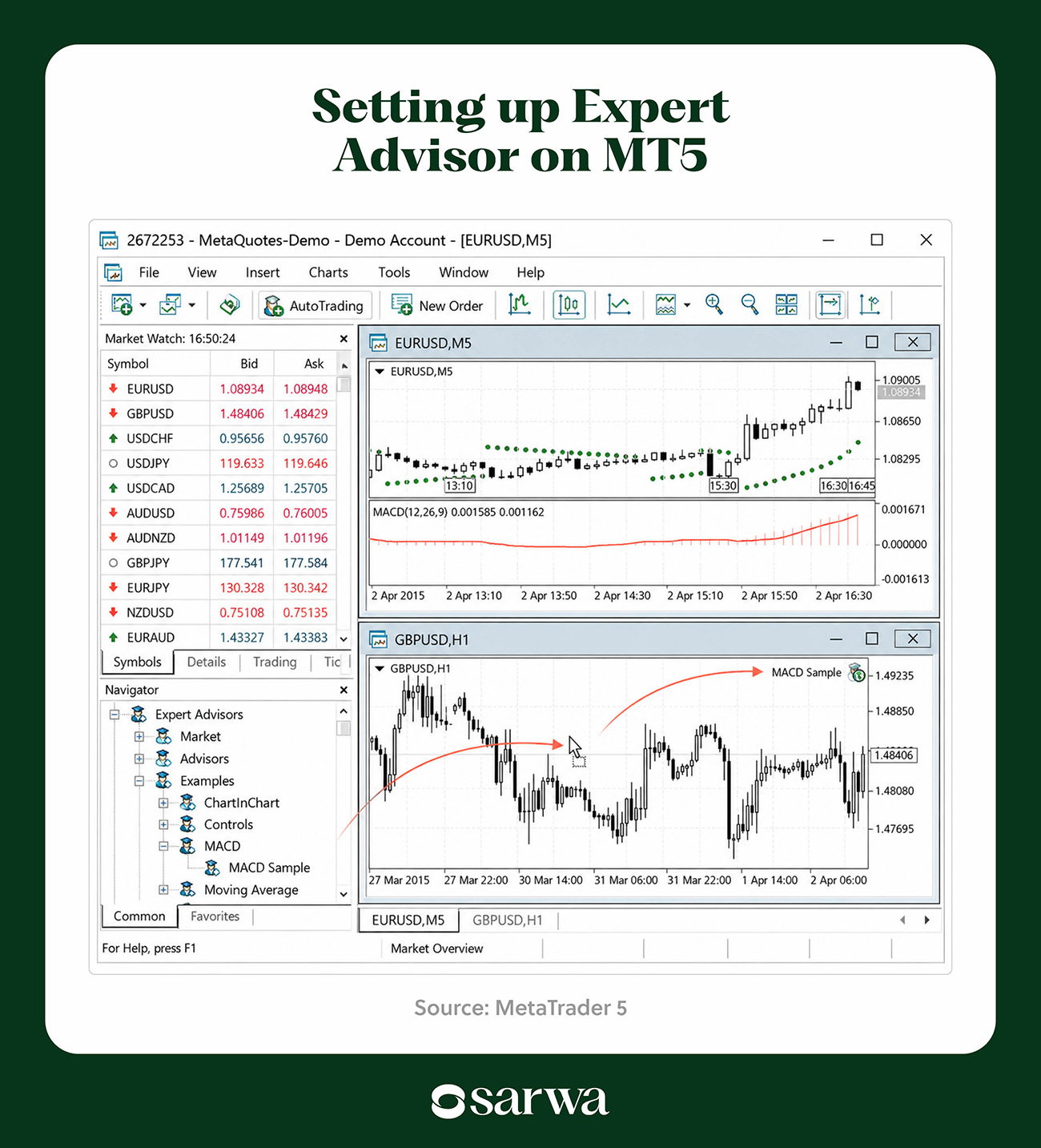
Source: MetaTrader 5
- cTrader Algo: cTrader Algo is the automation tool built into the cTrader trading platform. With this, you can design, test, and deploy trading robots (called cBots) and custom indicators, provided you have the requisite coding knowledge.
- Capitalise.ai: Most algorithmic trading platforms require coding knowledge, which many traders do not have. Capitalise.ai seeks to change that by allowing you to set up trading automations using natural language.
They also allow you to backtest your strategy so you can be more confident about the potential performance of your automated trades.
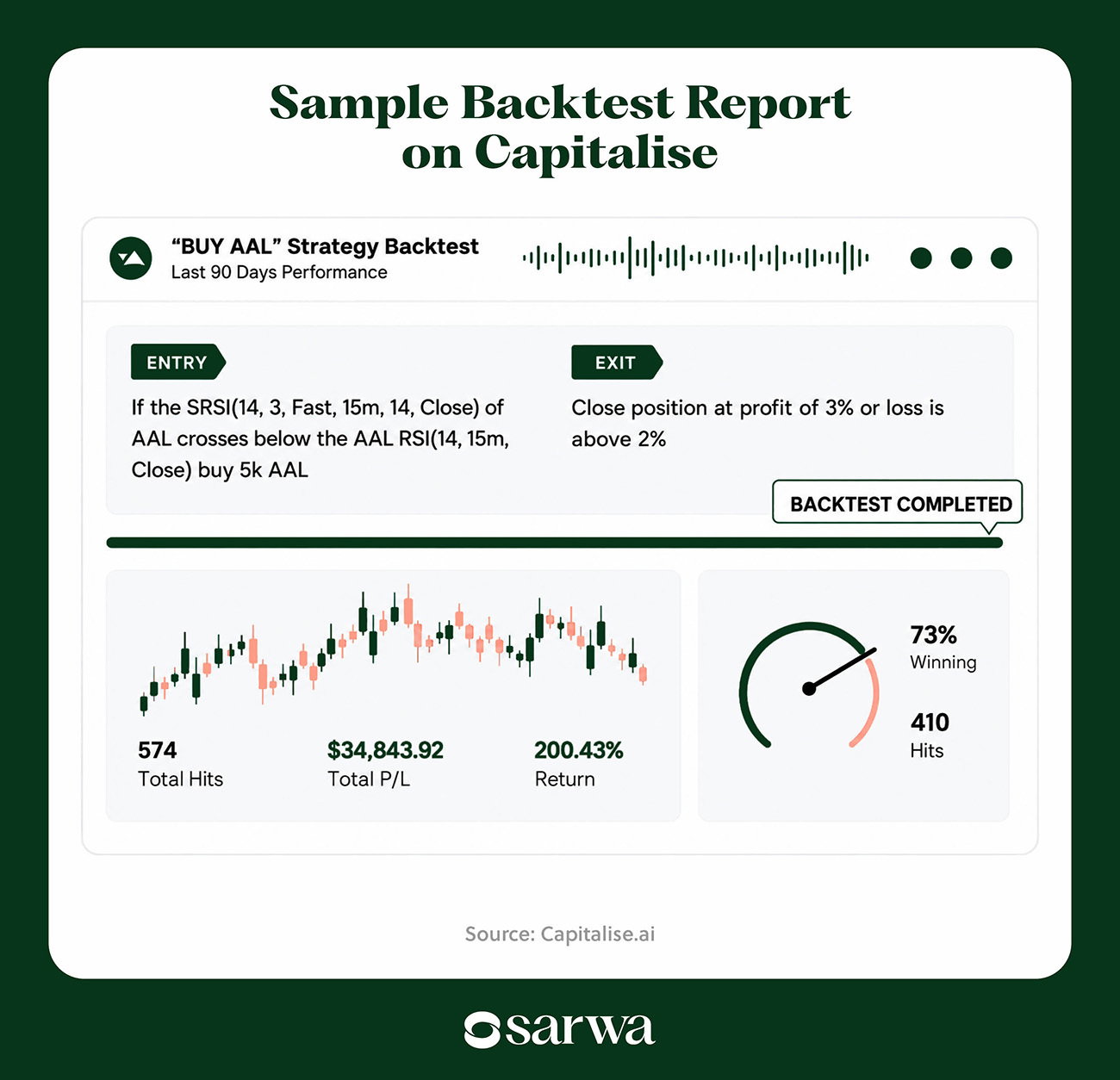
Source: Capitalise.ai
3. Using AI to trade stocks: The evaluation stage
Now that you have used AI algorithmic trading to create your investment or trading portfolio, it’s time to evaluate that portfolio and improve its performance.
Below are some options to consider:
- Use LLMs to identify weaknesses in your investment portfolio: LLMs can provide you with an objective critique of your portfolio and suggest improvements that will help you achieve your goals.
Some prompts you can use include: “How concentrated is my portfolio, and how do you suggest I rebalance it to achieve a better risk-return profile?” “Stress-test my portfolio against rising inflation and interest rates, how well does it perform, and how can I improve its performance?” “Evaluate the income performance of this portfolio, given my retirement objectives. What adjustments do I need to make to achieve a reliable income stream in retirement?”
- Use Edgewonk, TraderSync, TradeZella, and SNACS to monitor and review your performance: Edgewonk is a trading journal and performance analytics platform where you can upload your trades and monitor your performance.
The platform provides you with metrics like win rate, expectancy, drawdown, and risk-reward ratio. It also monitors how your emotions affect your trades and reveals which of your strategies is truly working. It can also model how small changes in your approach can affect important metrics.
TraderSync offers the same features but with a cloud-based interface and mobile accessibility. TradeZella is another option, but with a stronger emphasis on data visualization and trader psychology.
SNACS.Trade also has a trade journaling and performance evaluation product in addition to its stock screener.
- Backtest your strategy with your AI trading app: If you didn’t backtest your strategy before executing it with one of the automated stock trading AI products, you can do it at this stage.
Though past performance does not guarantee future performance, it can give you a good insight into the effectiveness of your strategy.
You can also use the Strategy Tester tool provided by TrendSpider.
4. How to wisely approach AI stock trading
AI stock market trading can help you conduct better analysis, execute trades more efficiently, and improve your trading and investment performance.
However, to get the best results from these AI-powered platforms, you need to embrace certain important principles.
- AI is not a replacement for human judgment: AI models sometimes provide inaccurate information. Therefore, when dealing with high-stakes decisions, you might need to review the results of AI models to avoid acting on incorrect information.
Even when AI models provide accurate information, there is also the issue of interpretation. This is where your expertise and experience matter. AI can tell you that a company’s P/E ratio is high, but it is up to you to decide if the projected growth rate justifies it.
“I do not foresee a time when humans will no longer be required to act as investors due to artificial intelligence,” said Andrew Gosselin, a Certified Public Accountant (CPA) and senior contributor at Save My Cent, a coupon database. “With increasing usage of AI, I anticipate that the competitive advantages of being able to obtain data will begin to diminish, while the investors who will consistently achieve superior performance will be those capable of effectively analyzing information, maintaining composure throughout uncertain times, and refraining from acting emotionally when market volatility exists.”
- Use AI as your personal critic: AI models can provide an alternative perspective that can help you identify your biases and simplistic assumptions. This can help you make better decisions.
“AI has primarily been helpful to me before investing any money,” said Noam Korbl, the Chief Financial Officer (CFO) of PropFirms, an independent prop firms review site. “I use it to dispute investment ideas, expose any hidden or non-obvious assumptions inherent in the idea, and emphasize any other potential risks that need to receive additional scrutiny. Most investors spend their time trying to convince themselves how well an investment will perform. AI can also provide surprising insight as to how poorly it could go.”
- AI models thrive on better prompts: ‘Better’ in this sense means at least three things.
First, provide detailed context about the situation to help LLMs provide quality output. For example, if you are asking LLMs to improve your portfolio, then you need to provide information about your time horizon, risk tolerance, and investment goals to get good results.
Second, to improve the accuracy of LLMs, specify the sources you want them to use. If you trust Stock Analysis or Yahoo Finance, for example, then you can instruct LLMs to use data from those sources. Or, as in the example above, you can limit your analysis to uploaded SEC filings.
Third, you can specify the role(s) you want the LLMs to play. This can help “constrain the style, depth, assumptions, and structure of the response,” according to Amitabh Roy Choudhary, a computer scientist at Adobe.
- Backtesting and paper trading remain crucial: Even when using AI models to conduct your analysis and design your strategies, you still need to backtest or trade with a demo account to be sure that the recommendations you are getting are really helpful.
- Combine multiple tools: No tool gives you everything you need for a comprehensive analysis, trade execution, and performance review. Combining multiple tools ensures that you are not focusing on only one aspect to the exclusion of others.
“I regularly use TradingView for AI-assisted chart analysis, market screening, and technical pattern recognition,” said Tapos Kumar, the founder of Finance Ideas, a personal finance management website. “I also use FinChat to review company fundamentals, historical financial performance, valuation metrics, and earnings-related information. Each tool serves a different purpose, like TradingView helps me to specify opportunities from a technical perspective, while FinChat helps determine whether the underlying business supports the investment thesis.”
After creating and improving your strategy, you need a trading platform you can use to execute it.
At Sarwa, we provide you with a platform (Sarwa Trade) where you can buy and sell US stocks, ETFs, and stock options.
With us, you can transfer money between your local bank accounts and brokerage accounts for free. We also process your deposits quickly so you can start placing your trades with no delays.
We provide market and limit orders to help you execute your trades at specific prices. Furthermore, our educational resources will help you improve your understanding of the market and your skills as a trader or investor.
Are you ready to trade US stocks in a cost-effective, convenient, and beginner-friendly way in the UAE? Sign up for Sarwa to begin your trading and investing journey.
Takeaways
- From research and trade execution to portfolio evaluation, AI tools can improve efficiency and decision-making at every stage of stock trading.
- Fundamental, technical, and sentiment analysis each require specialized platforms, and combining them often delivers better insights.
- AI can generate ideas and execute strategies, but traders must still verify information, manage risk, and interpret results.
- Better prompts, backtesting, paper trading, and continuous performance reviews are what turn AI tools into practical trading advantages.
Frequently Asked Questions
1. Can AI predict stock market crashes or major market movements?
No. AI can identify patterns and analyze historical data, but it cannot reliably predict unexpected events that often drive major market movements.
2. How much technical knowledge do I need to start using AI for stock trading?
Many AI trading software are designed for beginners and do not require programming skills. However, understanding the basics of investing and risk management will help you use these tools more effectively.
3. Is AI stock trading suitable for long-term investors, or only for active traders?
AI can benefit both long-term investors and active traders, although they tend to use different types of tools. Investors may focus on research and portfolio analysis, while traders often use AI for technical analysis and trade automation.
4. What is the biggest mistake beginners make when using AI for investing?
The biggest mistake is relying on AI recommendations without verifying the underlying information or assumptions. AI works best as a tool to support your decision-making, not as a substitute for your own judgment.