
What did you do the last time you purchased a stock? You probably contacted your broker or just clicked “buy” on a trading platform to buy a certain number of shares.
But not all people invest like that. Some will trade through complex financial instruments called derivatives, especially futures and options (F&Os).
This is where you start hearing what could be considered complex and confusing terms like strike price, expiration date, puts, calls, leverage, margin, and premium, among others.
What are futures and options in the stock market and why do some traders prefer them? We will seek to bring clarity to the world of derivatives by answering these questions and more. We’ll cover:
- What are futures and options in the stock market: A brief introduction
- How does stock trading differ from futures and options trading
- Why do people trade futures and options? The main pros
- Why is trading futures and options risky? The main cons
[Do you want to become a better trader by learning more about trading and the stock market? Subscribe to Sarwa’s newsletter today for regular educational resources.]
1. What are futures and options in the stock market: A brief introduction
Futures and options are some of the most popular derivatives among stock traders. But what exactly are they and how do they differ?
What is the futures market?
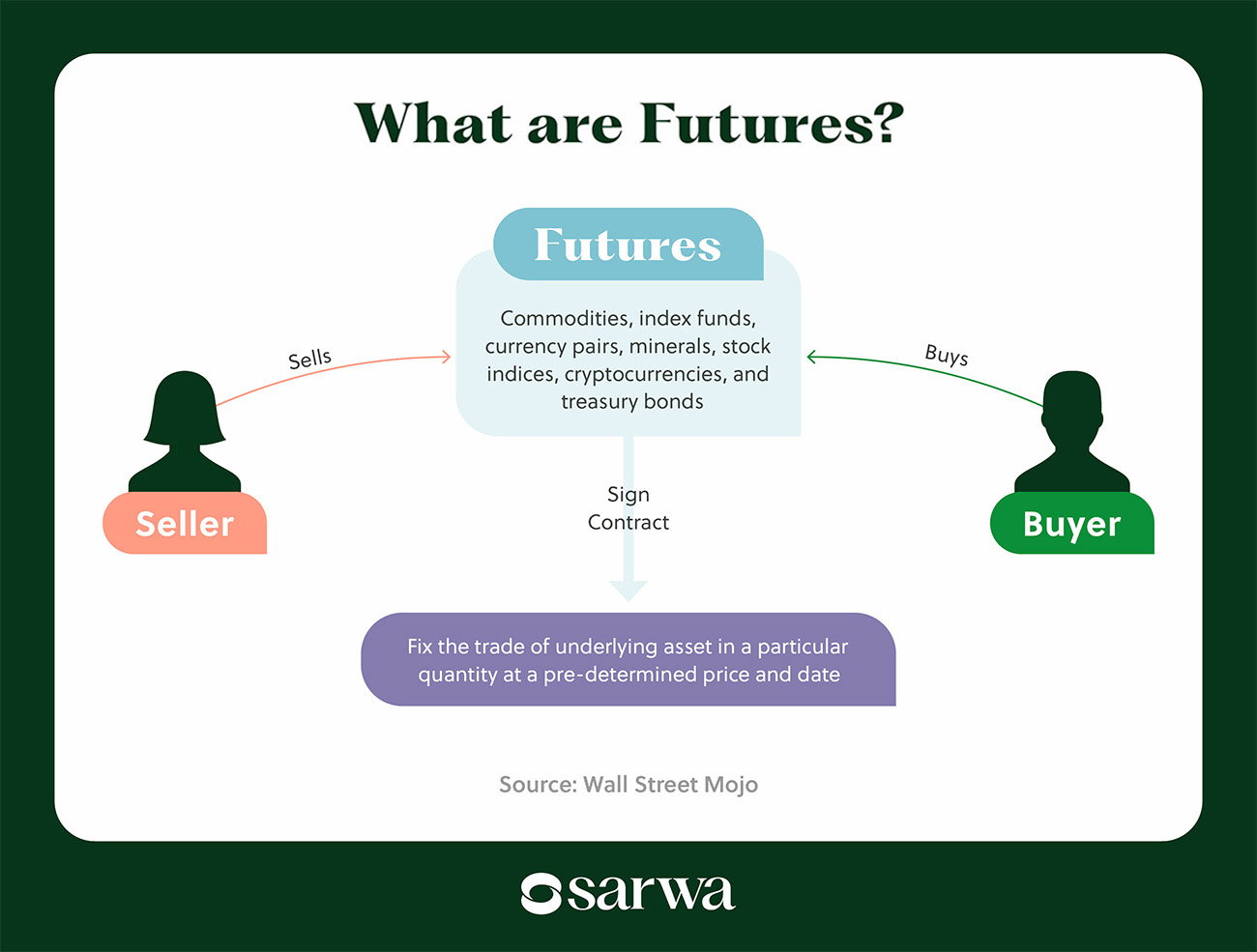
Futures are standardized derivatives that confer on the buyer the obligation to buy and the seller the obligation to sell an underlying asset for a specific price on a given date.
There are four main elements to a futures contract:
- Underlying security: There are futures contracts for the major securities – stocks, commodities, and cryptocurrencies – as well as for interest rate and market indices.
- Contract’s price: This is the price at which the futures buyer or seller will buy or sell the underlying security on the expiration date.
- Expiration date: Futures contracts typically expire on the third Friday of the expiration month (usually March, June, September, or December).
Most importantly, futures contracts cannot be exercised early (only on the expiration day).
- Contract size: For individual stocks, a futures contract represents 100 shares of the underlying security.
Contract sizes are a tad more complicated for index futures. A single contract is often the number of points in the index multiplied by a standardized multiplier.
For example, if the S&P 500 is at 5,000 points and a stock exchange has a multiplier of $50, a single futures contract will be worth $250,000.
Though futures and forward contracts are similar, there is an important difference: futures are standardized contracts (by quantity, asset delivery, and quality) traded on exchanges while forwards are customizable contracts traded over the counter (OTC).
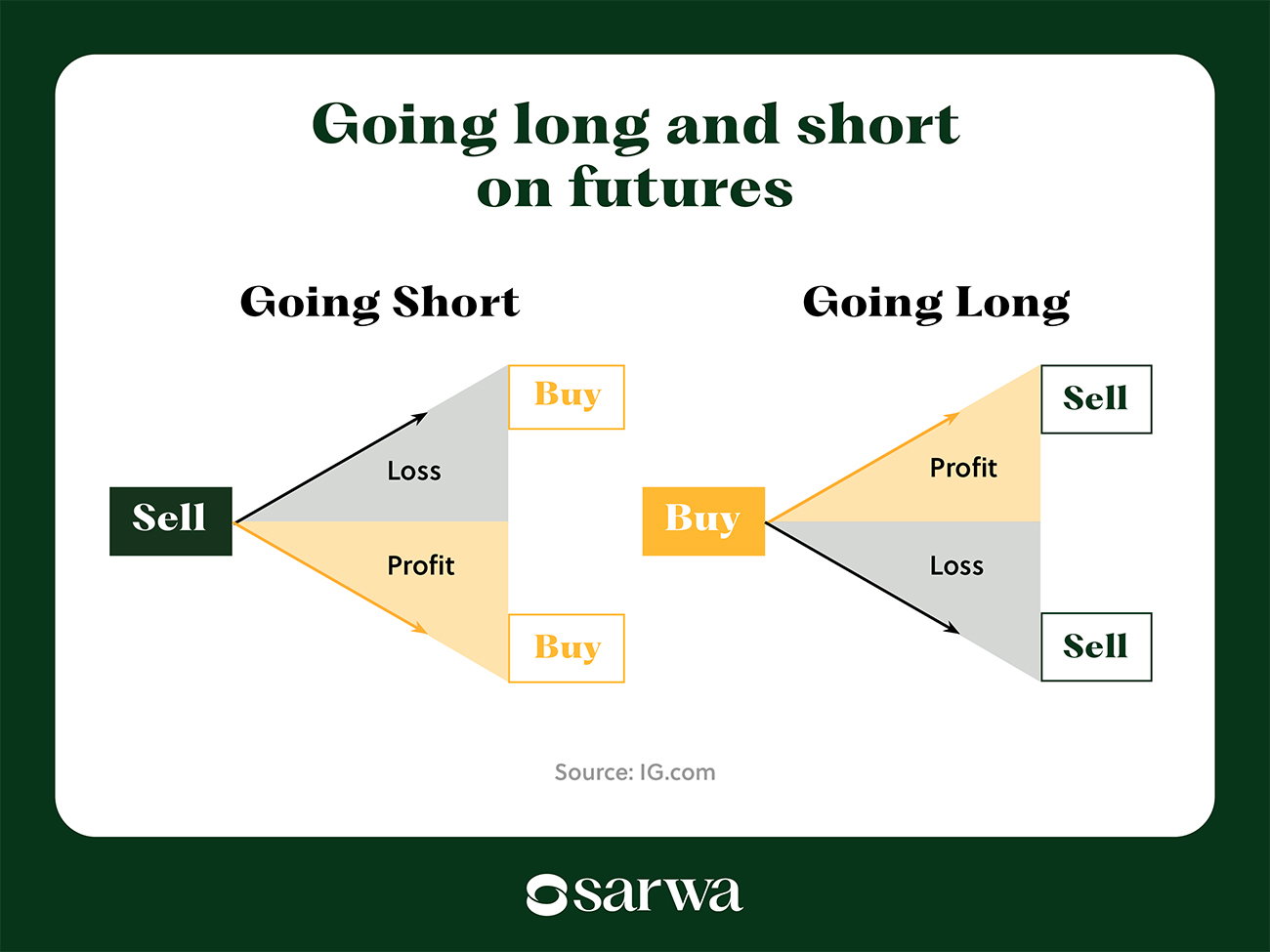
The trader with the obligation to buy in a futures contract is said to be taking a long position while the trader with the obligation to sell is taking a short position.
If you are interested in NVDA (NVIDIA’s stock), for example, and you think the price will increase from $300 to $350, you can purchase a futures contract with an exercise price of $300.
Suppose you are right and the spot price does go to $350 on the expiry date, you will buy for $300 and then sell at the current market price of $350 for a $50 profit per share. On the other hand, the trader who took the short position will make a loss of $50 per share.
What are options?
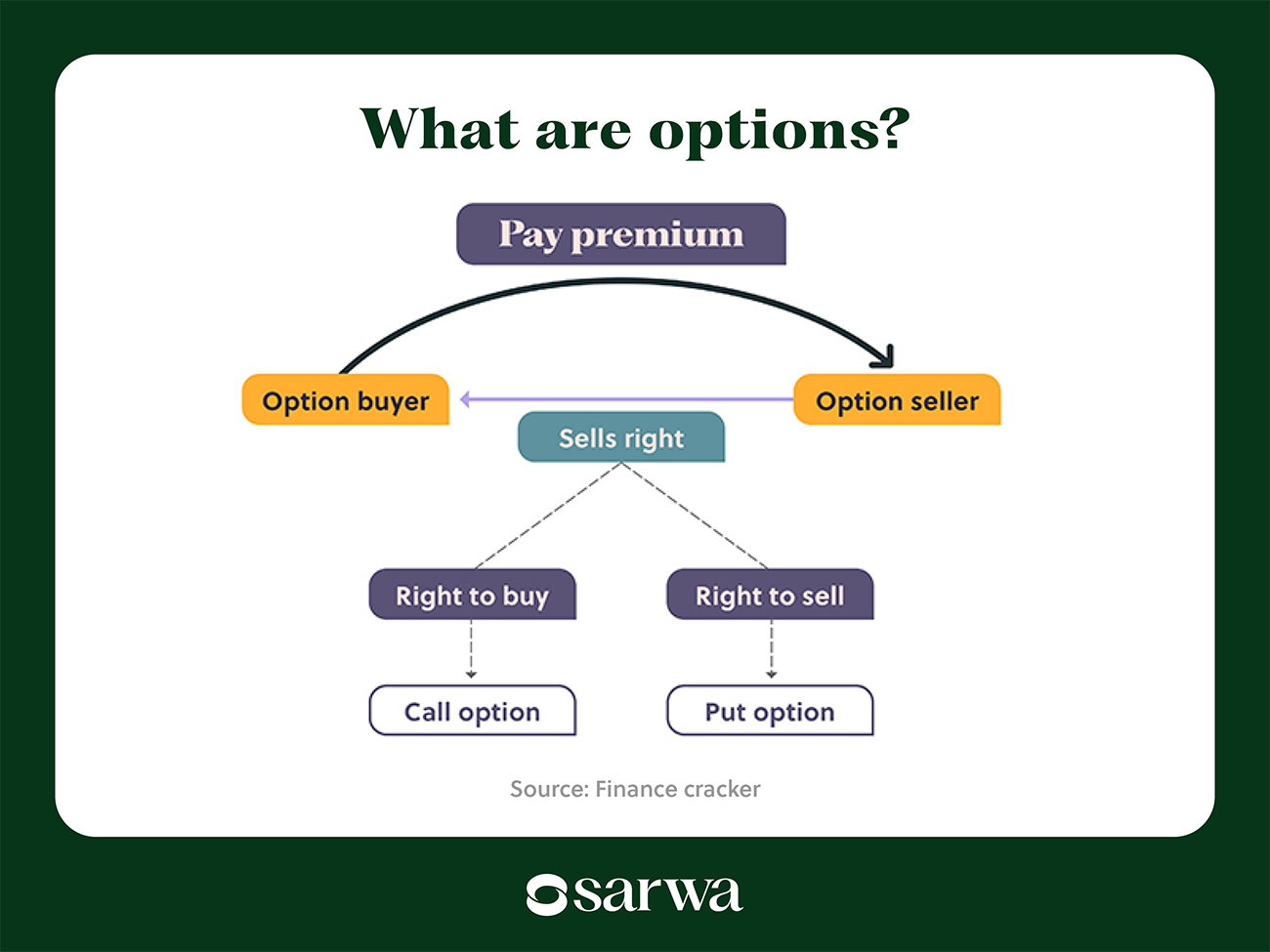
Options are financial derivatives that confer on the buyer the right but not an obligation to buy or sell an underlying financial asset at a predetermined price (strike price) on or before a certain date (expiry date).
There are two main types of options: puts and calls. A call option confers a right but not an obligation to buy a financial asset at a given price while a put option confers a right but not an obligation to sell.
Options trading in the stock market involve two parties: the buyer who has the right to buy or sell, and the seller who has the obligation to buy or sell whenever buyers exercise their right.
In other words, when option buyers exercise their rights to buy or sell, option sellers must take the other side of the contract.
Options are bought or sold as contracts. For stocks, a single option contract represents 100 shares.
Irrespective of the type, there are four key elements of every option contract:
- Underlying security: This is the financial asset on which the option’s value is based. In the case of options, stocks are the underlying security.
- Strike price (Exercise price): This is the price at which the buyer can buy or sell the underlying security at a future date.
- Expiration date: This is the date at which the option contract will expire. For American options, buyers can exercise the option on or before the expiration date. On the other hand, buyers can only exercise European options on the expiration date.
- Premium: The premium is the amount the option buyer pays to the option seller for the ensuing right. Option sellers can quote this price per share or contract.
Consider that you are interested in APPL (Apple’s stock). Let’s assume that the stock is selling for $200. If you believe the stock will rise to $250 in the coming weeks, you can purchase a call option if you want to still buy it at $200 by then.
Such a call option will have a strike price of $200. Let’s assume it expires in 4 weeks and the premium is $3.50 per share.
If the spot price rises to $250 two weeks later, you can exercise the call option at the $200 strike price (the seller now has an obligation to sell to you) and then sell it in the market for $250 for a $50 gross profit per share and a $46.50 net profit per share.
On the other hand, if you project a price drop to $150, you can buy a put option with a strike option of $200. If the price falls to $150 two weeks later, you can buy in the market at $150 and then sell to the option seller at $200 for a $50 gross profit and a $46.50 net profit per share.
What are the differences between futures and options?
For a clearer understanding of these two derivatives, let’s highlight the key differences between them:
- Obligation and right: Futures obligate both the buyer and the seller to buy and sell, respectively.
In contrast, options confer only a right to buy or sell on the buyer and the option seller’s obligation arises only when option buyers have exercised their rights.
- Exercise before expiry: While (American) options can be exercised early (before expiration), futures contracts can only be fulfilled on the expiration date.
- Buyers and sellers: Note that while a futures buyer can only buy the underlying security at expiration, an options buyer can either buy (call option) or sell (put option) the underlying security.
Similarly, while the futures seller can only sell the underlying security at expiration, an options seller can either buy (put option) or sell call option) depending on whether the buyer exercises the option.
- Premium: The options buyer will pay an upfront premium to the options seller in exchange for the right to buy or sell. With futures, there are no upfront payments since both parties are obligated to act.
- Zero-sum transactions: Since both the buyer and seller must act to buy or sell in a futures contract, one party is sure to lose while the other makes a profit if it is held until expiration.
On the other hand, if the options buyer does not exercise a right to buy or sell, no one loses or gains on the contract. In this case, the only transfer of value is the premium paid.
- Underlying asset: Options are mainly used for stocks (and stock indices) while futures have a more extended use – stock futures, indices futures, commodities futures, and crypto futures, among others.
2. How does stock trading differ from futures and options trading?
Before evaluating the reasons why some traders prefer futures and options trading (F&O trading) instead of stock trading, let’s consider the differences between these choices.
Stocks and options differences
Let’s start with the differences between trading option contracts and stocks:
- Ownership: When you buy stocks on a stock trading platform, you have direct ownership in the company. However, options only confer on you the right to buy or sell, a right you may end up not exercising.
- Capital requirement: To buy a stock, you need to put out all the money required. However, you only need to pay the premium to enter into an option contract. If you don’t exercise the option, you don’t need to part with the money required to buy the underlying security.
- Time: Unlike options, stocks don’t have expiration dates.
- Trading strategies: You can only go long or short on a stock while there are many stock option trading strategies to explore.
- Trading commissions: The commissions you will pay when trading options contracts are higher.
- Closing a position: You close a stock position by selling your shares. On the other hand, you can close a position in an option by selling or buying that position (to realize the profit or loss), rolling your position, exercising early, or holding until expiration.
Stock trading vs futures trading
What about stocks and futures? Below are the main differences:
- Time: Futures contracts expire but stocks don’t.
- Ownership: While the ownership of a stock is immediate, futures defer possible ownership to a future date.
- Role of margin: For stocks, margin (or leverage) involves borrowing money from the broker to buy more shares.
Margin is a good faith deposit in a futures contract. It indicates your readiness and ability to supply what is needed to carry out your obligation in the future. This is why the margin requirement is a percentage of the contract’s value.
- Closing your position: With futures, you can close a position by rolling it over to a further expiration date, buying or selling the contract (to realize the profit or loss), or settling it by buying or selling the underlying asset.
3. Why do people trade futures and options? The main pros
Now we have gotten to the important question we asked at the beginning: why go through the complexity of derivatives like futures and options?
Below are six reasons why people trade futures and options:
Hedging risk
Traders can use both options and futures contracts to hedge against certain market risks. These traders are often called hedgers and can include individuals as well as mutual funds and other institutional investors (who include them as part of a risk management strategy).
For example, a trader going long on an underlying asset can buy a put option to hedge against the risk of price falling instead of rising. Consider Investor A who went long on AAPL at $200. They can hedge against the risk of a fall in price by purchasing a put option with a strike price of $200.
If the price falls to $150, they can exercise their put option by selling at $200 instead of $150, thus avoiding a potential loss of $50 per share and limiting possible losses to the premium paid to the options seller.
In general, options provide limited risk for the buyer since they can choose not to exercise the option thus losing only the premium paid.
Investor A can also hedge against the same risk by shorting a futures contract (obligation to sell).
Magnifying returns
The leverage provided by options and futures contracts can help to magnify returns.
For example, you can enter into a futures contract worth $20,000 ($200 per share, 100 shares) by only putting down $2,000 per contract (for a 10X leverage). If you are going long and the price increases to $250, the entire contract is now worth $25,000, for a 12.5X return.
Without leverage, this would have been a 1.25X trade.
Earning income
Selling options is a good way to earn income without even having to buy or sell stocks.
If you sell a call option and the stock’s price falls, the buyer will not exercise the option and you can keep the premium.
Similarly, if you sell a put option and the stock’s price rises, the buyer will not exercise and you can keep the premium.
Market efficiency
Since no one has access to a magic ball that can predict future prices, insider trading, which mars stock trading, cannot affect options and futures.
Thus, options and futures can be seen to be more efficient.
Easier to go short
Not all trading platforms allow you to go short on stocks. For those who allow, regulations may be intense and complex.
With futures and options, you can go short either by selling a futures contract or buying a put option, respectively.
Liquidity
Future markets are very liquid which means you can readily open or close large positions without significant price changes.
Some stock exchanges even allow extended hours trading (trading outside normal trading hours), adding to its liquidity.
4. Why is trading futures and options risky? The main cons
Yet, not all that glitters is gold. Even if it’s gold, there might be some little dross here and there.
Certain risks make futures and options largely inappropriate for beginner traders. Let’s review some of these below:
Magnify losses
In the same way that leverage can magnify your returns, it can also amplify your losses. If the market goes against you, you can receive margin calls on your futures account and lose more than your initial margin.
Similarly, some option trading strategies used by speculators (those who want to profit from price fluctuations without any intention of acquiring the underlying stock) can significantly amplify losses.
An example is the uncovered short-call strategy (selling a call option when you don’t own the underlying security). If the strike price is $50 for instance and the stock’s price rises to $150, you will have to buy in the market at $150 and sell for $50, for a $100 loss per share.
Given that the stock’s price does not have a limit on the upside, such strategies can result in significant losses when the stock makes a rapid movement before or on the expiration date. Consider how the calculation above changes if the stock’s price rises to $300.
Volatility
Option prices are very volatile – even more volatile than stock prices. So, if you consider stocks to be very risky, options might end up being too risky for you.
Complexity
Both options and futures are very complex financial instruments and not everyone has the time or the inclination to understand them in depth.
Time value decay
Also, as options and futures contracts get closer to their expiration dates, their time value reduces. Holding them close to or until expiration may not be profitable and many of them can expire worthless depending on market conditions.
Physical delivery
In the case of futures contracts, holding them until expiration may require that the seller deliver and the buyer take delivery of the underlying security. In the case of stocks, this means that the full amount of the contract must be paid or received.
For example, if you used a $2,000 margin to enter into a $20,000 contract and wait until expiration, you will have to buy or sell $20,000 worth of the underlying stock to fulfill the contract.
Should you trade stock options and futures?
In sum, options and futures have massive advantages but only the more experienced traders can handle the risks involved with them.
If you are a beginner trader, you should stick to learning how to buy stocks in the UAE only. However, if you have the requisite experience (in addition to high risk tolerance and capacity), you can take advantage of options and futures to achieve your trading or investment objectives.
You can do this in the UAE through the Sarwa Trade app. We provide you access to some of the most popular US stock options (in addition to stocks and ETFs), allowing you to execute your stock options trading strategies with ease.
Our trading platform is simple to use, secured with 256-bit bank-level security, and user-friendly. In addition, you can transfer money from your local bank account to your brokerage account for free and enjoy competitive commissions.
[Are you ready to trade stock options in the US from the UAE? Sign up for Sarwa Trade for a seamless, secure, and cost-effective trading experience.]
Takeaways
- Futures and options are derivative contracts that provide an alternative option to gain exposure to stock price movements.
- While futures confer an obligation to buy or sell an underlying security at a specific price on a specific date, options confer on the buyer a right but not an obligation to buy (call) or sell (put) the underlying security.
- Traders like futures and options because they can help magnify returns, hedge against risk, and enhance market efficiency.
- However, derivatives trading can be risky, volatile, and very complex.