
Few investors inspire as much fascination and debate as Michael Burry.
Though he was known for his contrarian calls in the early years of founding Scion Capital, he became even more popular in popular culture when he predicted and profited from the 2008 housing market collapse.
His success was chronicled in the book The Big Short by Michael Lewis and in a movie by the same title (where Christian Bale played Michael Burry).
Since then, investors and investment experts have watched out for Michael Burry’s predictions with keen interest. Some that were dismissed as alarmist turned out to be remarkably accurate years later, while others that attracted headlines failed to play out as he forecasted.
Nevertheless, Michael Burry’s insights remain a good source of investing wisdom, especially for active investors. His thoughts on contrarian investing, fundamental research, risk management, and concentrated bets continue to inspire many investors.
In what follows, we will explore 20 Michael Burry quotes that introduce us to his investment philosophy and how he interprets financial markets. We will also try to separate his fundamental thoughts from his specific predictions to unearth the enduring wisdom he leaves us even when his predictions failed.
We’ll cover
- Michael Burry quotes on value investing and fundamental analysis
- Michael Burry quotes on risk management
- Michael Burry quotes on long-term thinking
- Michael Burry quotes on financial markets stability and weakness
- Michael Burry quotes on contrarian investing
Do you want to learn more about how successful investors spot opportunities? Subscribe now to Sarwa’s Fully Invested newsletter for the latest insights on global financial markets.
Michael Burry quotes on contrarian investing
1. “My natural state is an outsider, and no matter what group I’m in or where I am, I’ve always felt like I’m outside the group and I’ve always been analyzing the group.”

Michael Burry’s contrarian approach to investing did not start with the Big Short. At Scion Capital, he shorted the stocks of many internet companies during the dot-com bubble of the late early 2000s.
Even after the Big Short, he raised concerns about the inflationary impacts of the post-COVID 19 expansionary policies when other experts thought inflation was temporary.
In 2021, he announced he was short Tesla and advised Elon Musk to cash in on the stock because it was overvalued.
Burry has also raised concerns about overvaluation in the AI investment space just at the time everyone is excited about the technology.
In other words, Burry has never minded sharing ideas and opinions that are different from those of other members of the investment and fund managers community.
It is no wonder then that he described himself to Michael Lewis, the author of The Big Short, as a natural outsider who does not mind going against group consensus.
2. “I just really like to find my own ideas.”

Burry was known for running an investment blog during his medical residency at Stanford, according to Complete Trader’s Edge, a trading and investment blog. It was during this time that his deep analysis of the markets got the attention of Joel Greenblatt, the founder of Gotham Capital.
Since then, his investment approach has been marked by the same deep analysis.
He reads “what nobody else bothered to read: SEC filings, footnotes, credit agreements, and the fine print that companies used to hide unflattering information,” according to Complete Trader’s Edge.
With this deep analysis, Burry can find his own ideas instead of relying on Wall Street recommendations.
3. “If you are going to be a great investor, you have to fit the style to who you are.”
While he admired and respected some of the best investors in the world, like Warren Buffett, Benjamin Graham, and Peter Lynch, Burry insisted that every investor must have a strategy that matches their temperament.
This idea matches the emphasis on time horizon and risk tolerance in modern portfolio management. Instead of copying a generic portfolio, investors are best served with a personalized portfolio that is well adapted to their time horizon and risk tolerance.
4. “People want an authority to tell them how to value things, but they choose this authority not based on facts or results.”
As part of the Big Short conversations with Michael Lewis, Burry criticised investors who rely on experts rather than conducting independent analysis.
For him, the best ideas come when you dig deep into the financial documents yourself rather than rely on others’ recommendations.
5. “I have always believed that a single talented analyst, working very hard, can cover an amazing amount of the investment landscape, and this belief remains unchallenged in my mind.”
Given the time it takes to do deep research on any given stock, it might appear that it is impossible to cover more than a few stocks.
Not for Burry. He believes that a talented and diligent investment analyst can still cover a good amount of the investment landscape.
This is evident in his own experience, as Michael Burry’s portfolio often comprises tens of well-researched stocks at any given time.
Michael Burry quotes on value investing and fundamental analysis
6. “I try to buy shares of unpopular companies when they look like road kill and sell them when they’ve been polished up a bit.”
In one of his MSN MoneyCentral articles, Burry described his investment philosophy as looking for value in out-of-favor industries.
While describing this approach, he mentioned that he focuses on unpopular companies that the market is currently undervaluing and holding them until the market begins to see their true value.
Michael Burry’s portfolio has included companies like Western Digital, PulteHomes, Weyerhaeuser, Bethlehem Steel, Alcoa, International Paper, and Newmont Mining, which he purchased when they were out of favor.
In terms of unpopular industries/sectors, he purchased stocks of prison operators, infrastructure companies, and agricultural firms even when analysts were not looking at them.
He called this strategy “Ick investing.” Below is how he describes it in another context:
“’Ick investing’ means taking a special analytical interest in stocks that inspire a first reaction of ‘ick.’ I tend to become interested in stocks that by their very names or circumstances inspire unwillingness – and an ‘ick’ accompanied by a wrinkle of the nose on the part of most investors to delve any further.”
7. “As my moniker implies, I’m a value investor. A pretty deep one. Yet while my influences are traditional, I’ve developed my own version of value investing. This version has been tuned empirically with a singular goal: maximize risk-adjusted returns.”
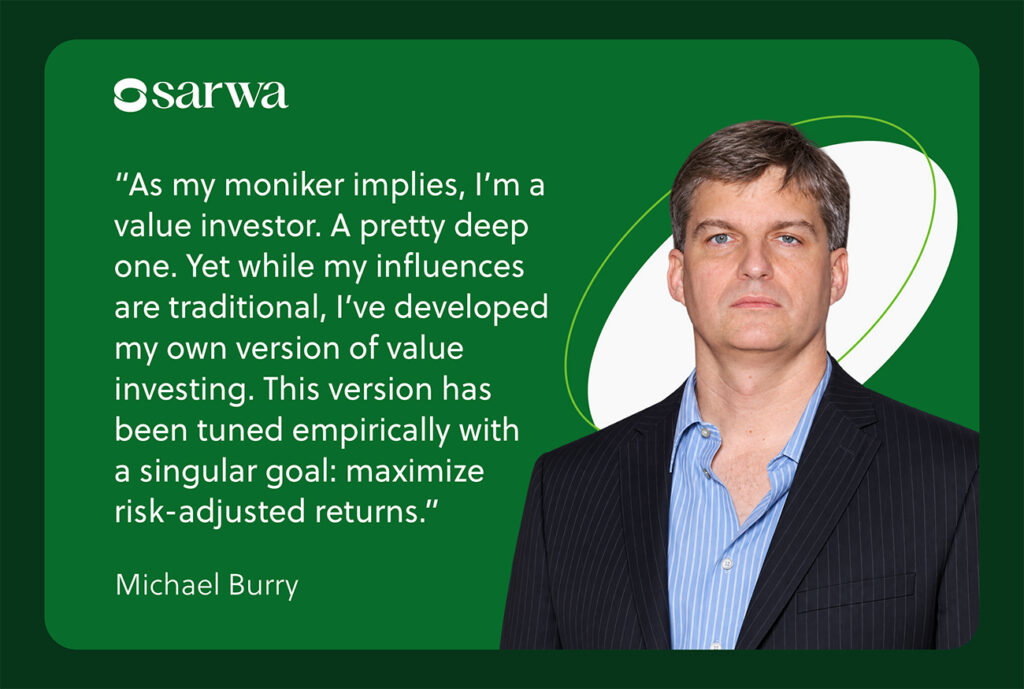
In an article written for MSN MoneyCentral in 2000, Burry admitted to being a value investor, in the school of Warren Buffett and Benjamin Graham. In other words, he seeks to purchase quality stocks when their market price is below their intrinsic value with a margin of safety.
However, Burry has adapted the principles of value investing to fit his own strategy, which is based on maximizing risk-adjusted returns. This is why he didn’t blacklist technology companies when others were doing it. For him, technology stocks could be good buys if their risk-return profile was still good enough.
8. “In essence, the stock market represents three separate categories of business. They are, adjusted for inflation, those with shrinking intrinsic value, those with approximately stable intrinsic value, and those with steadily growing intrinsic value. The preference, always, would be to buy a long-term franchise at a substantial discount from growing intrinsic value.”
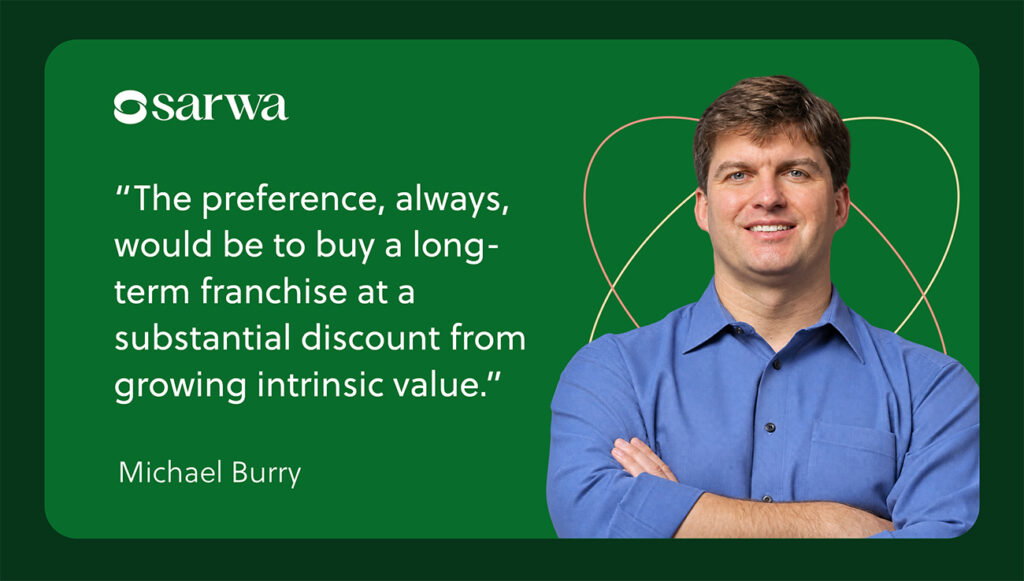
In a 2001 letter to his shareholders, Burry explained his approach to selecting stocks, especially in a market marked by speculative excess on both the upside and the downside.
He attempts to separate listed businesses into three categories – those with shrinking intrinsic value, stable intrinsic value, and steadily growing intrinsic value.
As a value investor, Burry prioritizes companies with steadily growing intrinsic value. Also, he focuses on long-term value and purchases these companies when they are selling at a discount to their growing intrinsic value.
9. “I don’t take breaks in my search for value. There is no golf or other hobby to distract me. Seeing value is what I do.”
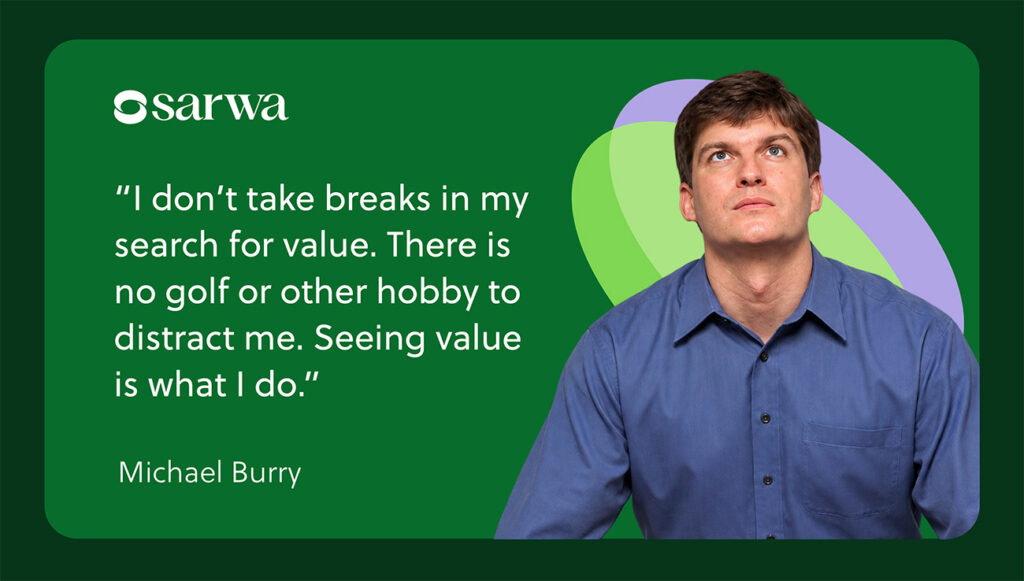
Burry said above that a diligent investment analyst with the right skillset can cover a large portion of the investment landscape. It turns out that this is exactly what he does.
Some may call him an investing fanatic, but Burry has built his success and reputation on spending hours going through companies’ filings to unearth their intrinsic value. For him, only such an ‘obsession’ with finding value can lead to success.
10. “The late nineties almost forced me to identify myself as a value investor, because I thought what everybody else was doing was insane.”
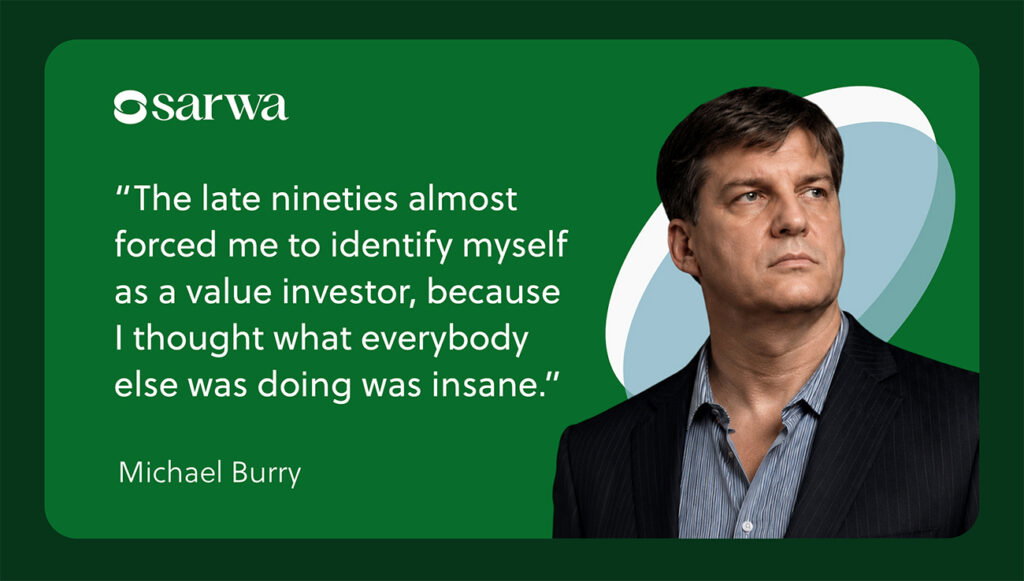
While everyone was buying the hype in the dot-com bubble, Burry was researching the fundamentals of these companies to decide if they were undervalued or overvalued. This led him to profit from shorting many internet stocks at a time when many people were hopped up on the frenzy.
Also, while the obsession with internet equities led many analysts to overlook unpopular sectors and companies, Burry placed his bets on them because of their steadily growing intrinsic value.
11. “My weapon of choice as a stock picker is research; it’s critical for me to understand a company’s value before laying down a dime.”
As a value investor, Burry prioritizes fundamental research over everything else.
Though he sometimes uses technical analysis to time his entry, his priority is calculating an intrinsic value for every stock based on his research into their filings.
Michael Burry quotes on risk management
12. “I want to protect my downside to prevent permanent loss of capital.”
In the same article where he identified himself as a value investor who purchases unpopular companies when they are roadkill, Burry admits that he has his own version of the techniques of Buffett and Graham.
According to him, all his adaptations of these techniques were designed to protect himself from permanent loss of capital.
In other words, while many analysts were measuring risk by volatility, Burry understood that true risk is the possibility of a permanent loss of capital. This is another reason why he prioritizes maximizing risk-adjusted returns instead of absolute returns.
13. “Lost dollars are simply harder to replace than gained dollars are to lose.”
In one of Warren Buffett’s quotes, he said that the first investing rule is to avoid losing money. This is because only money that is not lost to the market can earn compound interest over the years.
Burry agrees with this sentiment. For him, recovering what was lost in the market is even harder than losing what was gained. His point is that adequate risk management is a crucial component of a sound investing strategy.
Michael Burry quotes on long-term thinking
14. “I seek individual investments that will allow me to target total portfolio returns of at least 20% annually after fees and expenses on an annual basis over a period of years, not months.”
In his 2000 letter to shareholders, Burry emphasized that his focus at Scion Capital is to consistently generate net total portfolio returns of at least 20% over many years.
Instead of chasing short-term returns, Burry focuses on building value for his shareholders over the long term. Such an approach makes sense given that it sometimes takes years before an undervalued stock’s market price aligns with its intrinsic value.
15. “My positioning with my investors was always, I need three to five years.”
This is a reiteration of the point about long-term investing. Burry did not promise quick returns but ensured that his investors had the same long-term horizon as the hedge fund.
Burry is proof that one can be an active investor while still having a long-term horizon.
Michael Burry quotes on financial markets’ stability and weakness
16. “What you want to watch are the lenders, not the borrowers. The borrowers will always be willing to take a great deal for themselves. It’s up to the lenders to show restraint, and when they lose it, watch out.”
In his 2010 Op-ed published by the New York Times, Burry reflected on what happened to the housing market leading to the crash.
His point here is that deteriorating underwriting standards on the part of lenders, rather than irresponsible borrowers, were the culprit. Borrowers will always take a deal that makes sense to them, but it is up to lenders to ensure that there are good underwriting standards in place.
Though the Great Financial Crisis is behind us, Burry’s point remains: the stability of financial markets often depends on the presence of stability-inducing regulations and a commitment to adhere to them.
17. “2000, 2008, 2023, it is always the same. People full of hubris and greed take stupid risks, and fail. Money is then printed. Because it works so well.”
After the collapse of Silicon Valley Bank (SVB), Burry had an interview with CNBC where he explained his thoughts on the role of human emotion in the ebb and flow of financial markets.
For him, most market collapses are down to the greed and fear cycle. Greed leads people to take too much uninformed risk, and hubris leads them to ignore the first signs that they made the wrong bets. By the time it becomes obvious that the bet was wrong, fear takes over, and the panic selling leads to a crash.
When the crash happens, the government intervenes with expansionary policies that steady the ship but often leave long-term impacts on the economy.
As said above, Burry believes a similar cycle is already developing in the AI space, though many investors disagree with the view that we are experiencing a repeat of the dot-com bubble. It remains to be seen whether Burry will be proved right.
18. “Back in 2005 and 2006, I argued as forcefully as I could, in letters to clients of my investment firm, ‘Scion Capital’, that the mortgage market would melt down in the second half of 2007, causing substantial damage to the economy.”
This quote comes from the Op-ed in The New York Times.
As said above, Burry became famous in pop culture due to his accurate prediction of the housing market’s collapse.
He saw the signs that euphoria, greed, and hubris were driving the market and positioned himself to benefit from the crash by shorting mortgage-backed securities (MBSs) through credit-default swaps. As he said in his interview with Lewis, “I’m not making a bet against a bond. I’m making a bet against a system”
Michael Burry’s net worth increased by $100 million when the crash happened, and he made over $700 million for shareholders of Scion Capital, according to Yahoo Finance. (He would later close Scion Capital in 2008 and launch Scion Asset Management in 2010).
More importantly, his success at shorting the housing market is proof that his conception of how the fear and greed cycle affects financial markets deserves close attention.
19. “I have a job to do. Make money for my clients. Period. But boy, it gets morbid when you start making investments that work out extra great if a tragedy occurs.”
In one of his conversations with Lewis, Burry discussed the emotional side of profiting from the housing market crash.
His point is that while he was doing his job – making money for his clients – there was an emotional discomfort that resulted from profiting from a tragedy.
Burry does not delight in financial crises, but that does not stop him from making more for his clients when they happen.
20. “It is ludicrous to believe that asset bubbles can only be recognized in hindsight.”
Many investors believe that the Great Financial Crisis is an example of a black swan event – an unpredictable event with large consequences that can only be seen as obvious or inevitable in hindsight.
But how can it be a black swan event if someone like Burry predicted it accurately?
This is the point Burry made in his conversation with Lewis. As we have seen, asset bubbles are often marked by similar patterns: greed, hubris, euphoria, and lax regulations. This makes it possible to identify them before they burst or even fully develop.
There you have it: 20 Michael Burry quotes that give us a sneak peek into his investment philosophy and understanding of the financial markets.
If you are a fan of active investing, you should learn from his focus on deep fundamental research, personal convictions, long-term thinking, value investing, risk management, and risk-adjusted returns over absolute returns.
More importantly, instead of copying Michael Burry, you should heed his advice and create your strategy as an adaptation of insights from the best investors in the world.
Instead of looking for specific recommendations, process the underlying principles and design your investment strategy.
Are you ready to design and execute your active investing strategy in the UAE? Sign up today for Sarwa Trade for seamless, secure, and cost-effective access to US stocks, ETFs, cryptocurrencies, and stock options.
Takeaways
- Michael Burry’s greatest edge wasn’t predicting crashes—it was thinking independently. His success came from questioning consensus and relying on deep research rather than following market sentiment.
- As a self-proclaimed value investor, Burry looked for companies trading below intrinsic value and often waited years for the market to recognize their worth.
- Risk management mattered more to Burry than maximizing absolute returns. Many of his quotes emphasize avoiding permanent losses and focusing on risk-adjusted returns over chasing quick profits.
- Even when Burry’s market predictions missed the mark, his investing principles remained remarkably consistent. His views on research, discipline, and investor psychology continue to offer lessons regardless of whether every prediction came true.