
An IPO can feel like a rare chance to get in early on the next big company. But while the idea of buying shares as a business makes its debut on the stock market is exciting, investing in an IPO is not as simple as spotting a promising name and placing an order.
For first-time investors, the real challenge is knowing how IPOs work, what to look for before investing, and which risks can turn a highly anticipated listing into a disappointing investment. This is especially important for UAE investors, who now have access to global markets through various investment platforms.
In this guide, we’ll break down the IPO investing process step by step, explain how to assess whether a new listing deserves a place in your portfolio, and show you what UAE-based investors should know before making their first IPO investment.
We’ll cover:
- What is an IPO?
- How to invest in an IPO? Understanding the IPO process
- Should you invest in an IPO? How to evaluate IPO opportunities
- The benefits and risks of IPO investing
- How to invest in IPO: Requesting IPO shares in the UAE
Do you want to learn more about how to spot opportunities in global markets? Subscribe now to Sarwa’s Fully Invested newsletter for expert insights.
1. What is an IPO?
An initial public offering (IPO) is the process through which a private company offers a portion of its shares to the general public on a stock exchange (like NYSE or NASDAQ) for the first time.
In other words, it is a procedure that turns a private company into a public company.
Private vs public companies
But what exactly is the difference between a private and a public company?
A private company is owned by a small group of people, usually the company’s founders, employees, and private investors (individuals, venture capitalists, or private equity companies). The shares owned by these groups are privately traded.
Since a small group owns them, there are fewer reporting requirements, and financial statements are often kept confidential. Also, any fundraising is done privately, usually through venture capital or private equity.
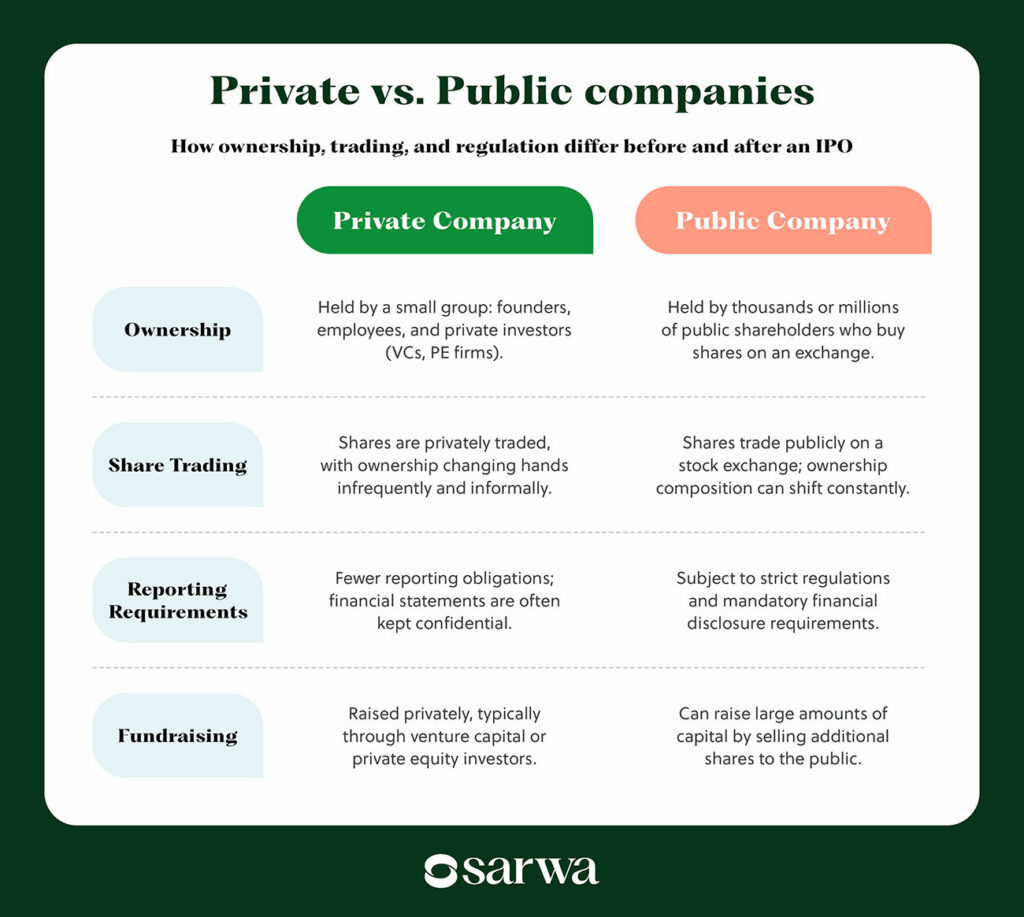
On the other hand, a public company is owned by thousands or millions of public shareholders who can buy and sell its shares on the stock exchange. Also, the composition of shareholders can change frequently as buying and selling activities take place.
What happens when a company goes public?
Public companies often follow strict regulations and financial disclosure requirements.
Also, public companies can raise large amounts of money by issuing more shares to the public.
Why do companies conduct an IPO?
Companies decide to go through the IPO process for various reasons. Below are some of the most popular ones:
- Raising capital: By selling some of their shares to the public, companies can raise capital for research and development (R&D), acquisitions, or market expansion.
- Improving visibility and reputation: Being publicly listed is often a signal of a company’s reputation and credibility. This is because going public requires strong regulatory compliance and adherence to financial disclosure requirements.
When a company’s reputation improves in this way, it can win more customers and talented employees.
- Providing liquidity for founders, early investors, and employees: The IPO process opens up opportunities for private owners to sell some (or all) of their shares in the open market and realize the value of their investment.
- Changing financing structure: Some companies also go public to raise money to pay off their debts. This results in a change in financing structure, as equity replaces debt.
2. How to invest in an IPO: Understanding the IPO process
We have seen that the IPO is the process whereby a private company goes public.
But how does an IPO work exactly?
It is to this question we now turn.
The IPO process often involves the following steps from the company’s point of view:
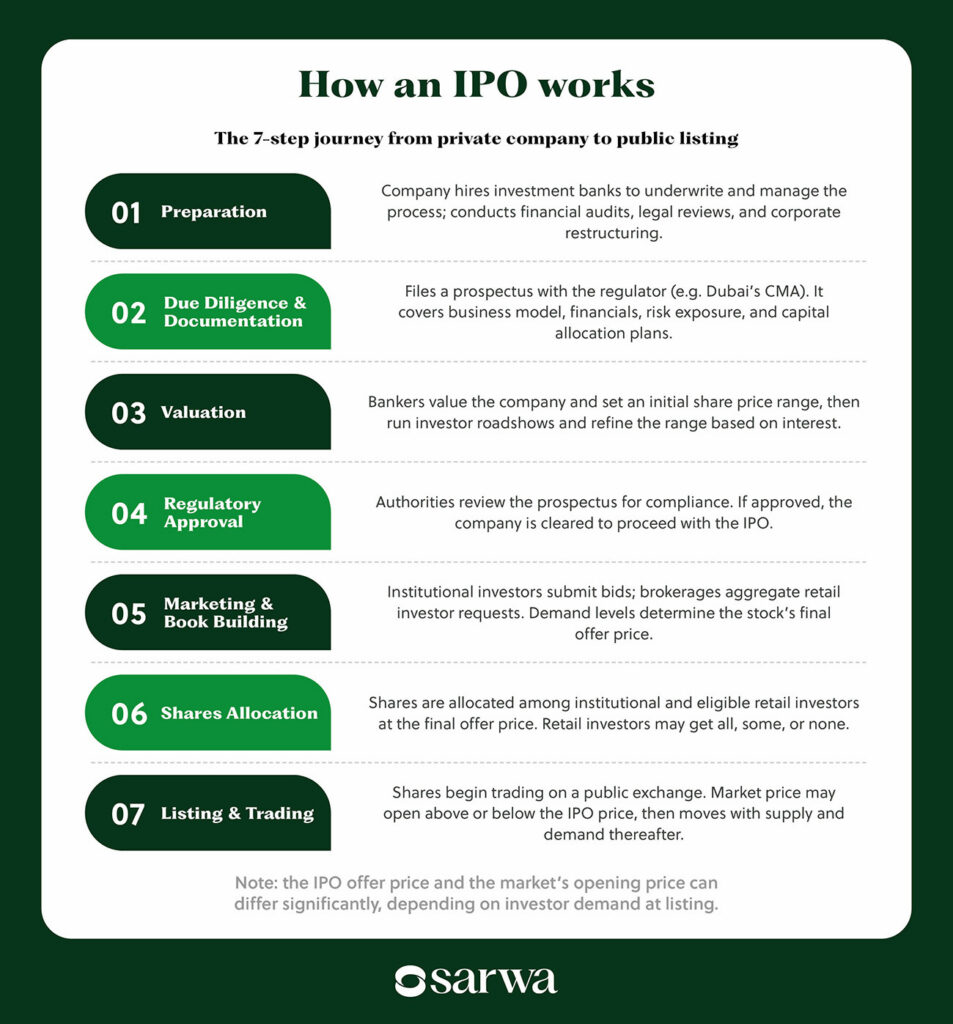
- Preparation: Once the company has decided to go public, they will hire investment banks who will underwrite and manage the process. As part of the preparation, they will need to conduct financial audits, legal reviews, and some corporate restructuring, in line with relevant regulations.
- Due diligence and documentation: The company will then proceed to file a prospectus with the relevant regulatory authority. For a Dubai IPO, this will be the Capital and Markets Authority (CMA), formerly known as the Securities and Commodities Authority (SCA).
The prospectus contains information like the company’s business model, financials, risk exposure, and capital allocation plans.
- Valuation: The investment bankers will value the company and determine an initial price (usually a price range). After this, they conduct roadshows where they present the company’s prospectus to institutional investors (mutual funds, pension funds, and hedge funds, among others). The investment bankers will refine the initial share price range based on the level of interest from investors.
- Regulatory approval: The relevant authorities will review the prospectus and ensure it complies with relevant requirements. If it does, they will grant regulatory approval, which opens the door for the company to proceed with the IPO.
- Marketing and book building: This is the stage where investors start submitting bids for shares in the company. These are usually institutional investors, who are often the targets of roadshows.
Some brokerage companies also aggregate IPO share requests from their users (retail or individual investors) and forward them to the underwriters. However, such requests are only an “indication of interest,” and there is no guarantee that retail investors will get allocation of shares.
The book-building process is important because the level of investor demand determines the stock’s final offer price.
Though the book-building offering is the most popular, some IPOs have used the fixed-price offering model. Here, the company sets a predetermined share price (often based on the valuation process conducted by the underwriters). Investors know exactly what they will pay when they apply for shares. The only factor they control is the number of shares they want to buy.
- Allocation of shares: Not everyone who wants IPO shares will necessarily receive them. When demand is high and the offer is oversubscribed, the available shares may be allocated among institutional investors and, depending on the offering and brokerage, eligible retail investors. In the end, a retail investor may receive all, a portion, or none of the shares requested.
The shares allocation takes place based on the final offer price.
- Listing and trading: On the IPO day, the company’s shares begin trading on a public stock exchange.
Importantly, the IPO offer price and the market price can be very different. If investors are highly optimistic, the stock could open above the IPO price. If demand is weak, it could trade below it.
After the IPO day, market forces take over, and the stock’s price on secondary markets will vary based on the interaction between sellers and buyers.
3. Should you invest in an IPO? How to evaluate IPO opportunities
Many individual investors get involved in the IPO process at the marketing and book-building stage. This is when they send in IPO share requests from their brokerage accounts in the hope of getting an allocation.
However, as we have noted, an IPO can go wrong.
We have seen cases of companies whose market price fell rapidly after the IPO day. For example, Pets.com fell by more than 98% (from $11 to $0.98 per share) within nine months from when it went public, according to Livewire Markets, a market analysis platform.
Even traders who want to quickly make a profit on IPO day can be disappointed. Funko, a collectibles manufacturer, saw its stock price fall by 41% on IPO day, wiping out more than $200 million of value, according to Livewire Markets.
The point?
Smart retail investors should get involved in the IPO process very early, ensuring they have a good grasp of the company’s fundamentals before making a request.
“Most investors focus on the buy and skip proper due diligence, but the real work happens before the listing date,” according to Steve Case, a financial consultant at Insurance Hero, a life insurance comparison tool. ”Research the prospectus and underwriters first, then set a holding plan before you buy, since panic selling early tends to lock in losses patience would have avoided.”
In other words, before considering how to buy IPO shares, you should learn how to evaluate IPO opportunities, especially if you are a long-term investor.
Below are some pointers:
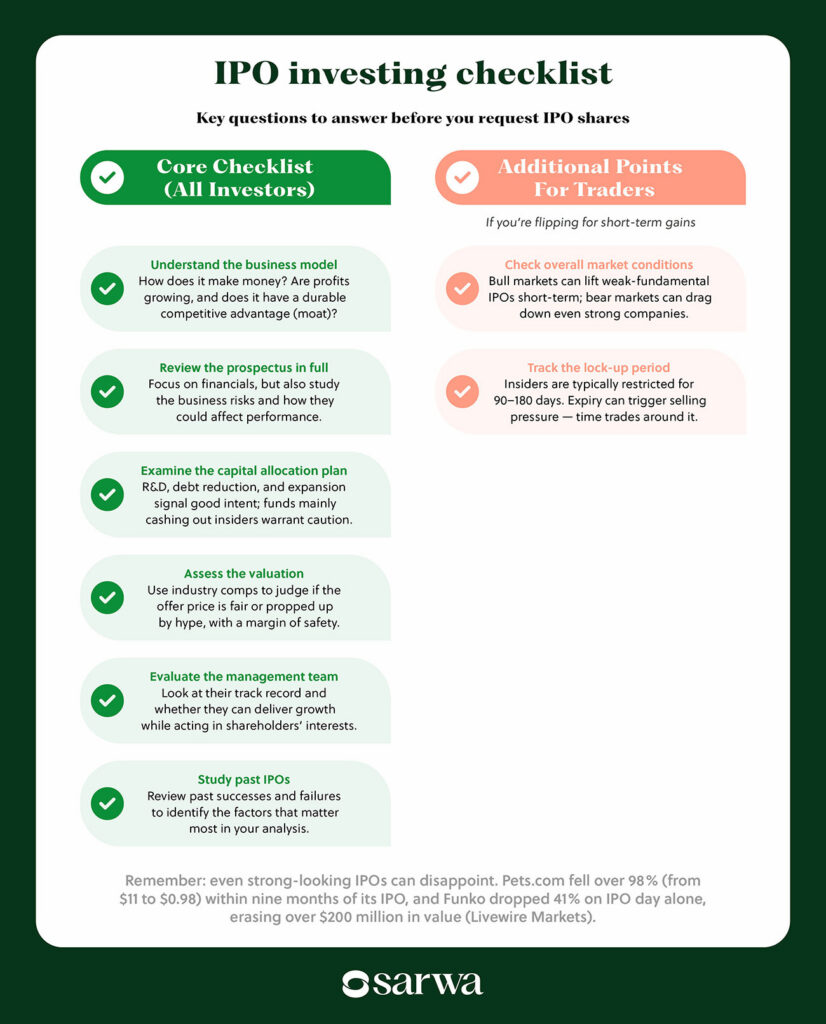
- Understand the business model: As anyone interested in stock market fundamental analysis understands, how the company makes money is often the most important pointer to its underlying value.
Consider if the company has growing profits or if there is at least a clear path to such. Also, evaluate the industry where it operates – is the industry growing and does the company have an economic moat (durable competitive advantage) that can position it as a leader?
A look at Warren Buffett’s stock holdings can give you more ideas on what to look for.
Though evaluating a company going through an IPO process is not as easy as assessing a public company, you should use all the quantitative and qualitative information you can get to make a sound judgment about its financial health.
- Review the prospectus: The IPO prospectus will typically contain some of the information you will need. While it is crucial to focus on the financials, don’t lose sight of the business risks component. Ensure that all relevant risks have been highlighted and their potential impact on stock performance has been clarified.
You should also not ignore the capital allocation section.
“Examine where funds are directed,” according to Kenny Loh, founder of REITsavvy, a REIT screener and education platform. “Capital allocated toward productive R&D, balance sheet de-leveraging, or revenue-generating expansion signals positive alignment. Capital primarily used to buy out pre-IPO private equity or existing founders warrants caution.”
- Review valuation: If you are a value investor, your goal is to buy a company when it is undervalued. You can use an industry comps analysis to determine (with margin of safety) if the IPO final offer is fair or if the company is being propped up by unjustifiable hype.
“For me, I combine a valuation that compares the still private companies to public counterparts and consider both the expiration of the lockup period and the revenue growth,” said Jacob Bayer, founder of Jacob Bayer Wealth Management. “If it is valued at a higher price than its public counterpart, that is a signal to me to wait.”
- Don’t neglect qualitative analysis: Beyond the numbers, consider the track record of the company’s management team. Are they the kind of people who can deliver on its growth projections while acting in shareholders’ best interests?
- Learn from past IPOs: Reviewing past IPOs that succeeded and failed can help you identify success factors that you should prioritize in your analysis.
If you are a trader who only wants to flip an IPO stock for short-term gains, you should consider the following additional points:
- Consider the importance of market conditions: IPOs launched during bullish markets are likely to ride the broader market wave, which can lead to short-term returns even if fundamentals are not as strong.
On the other hand, companies with strong fundamentals can still struggle in a bear market, which may make them inappropriate for traders.
- Consider the impact of lock-up periods: Insiders (founders, employees, private owners) are often restricted from selling their shares in the open market for the first 90-180 days. Depending on the size of shares, a wave of insider selling after the lock-up period can put a downward pressure on the stock price.
Thus, you should time your trades accordingly.
4. The benefits and risks of IPO investing
We have considered the benefits companies derive from going public. Now we shift attention to investors.
Why do investors like to participate in the IPO process? Below are some potential benefits they wish to enjoy:
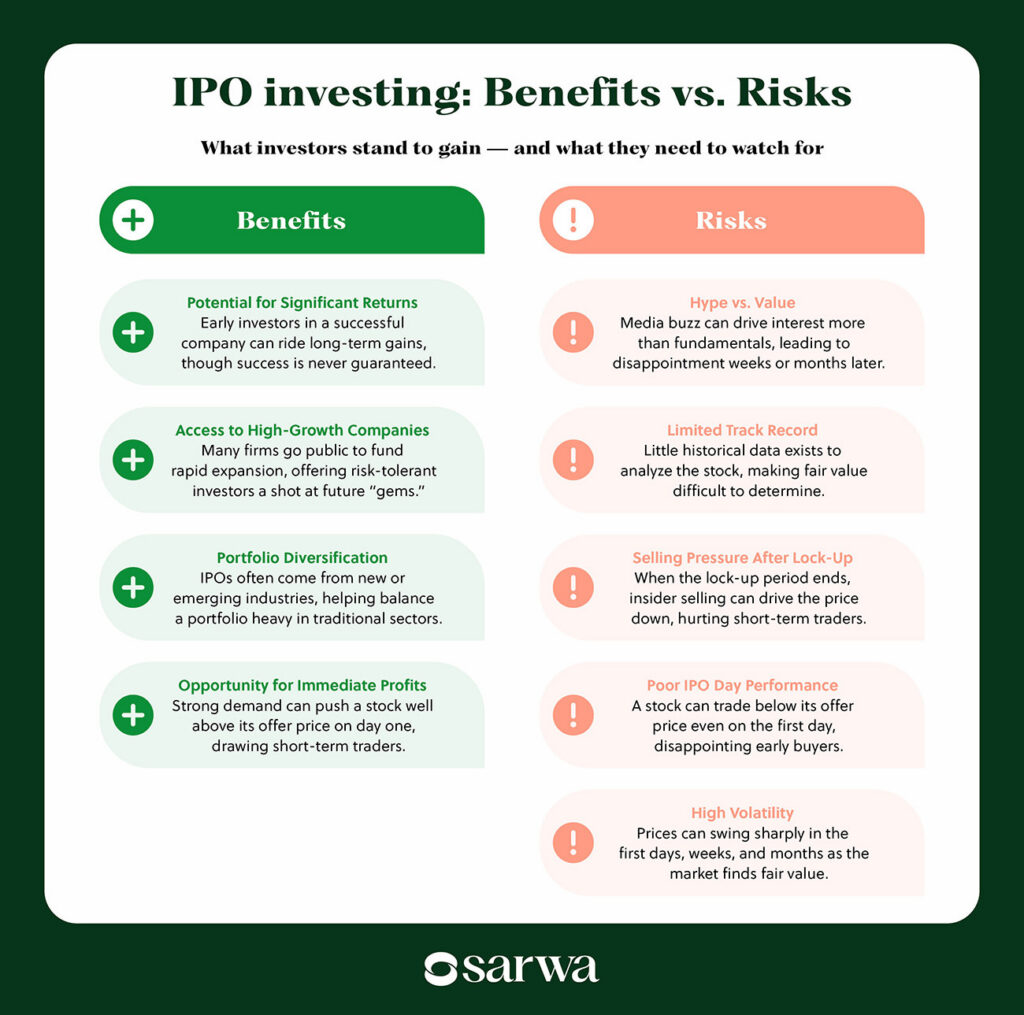
- Potential for significant returns: If a company does well after its IPO, those who got in early can ride the wave over the long-term (in terms of both dividends and capital appreciation). However, this is only a potential benefit as there is no guarantee that a company will succeed after its IPO.
- Opportunity to invest in high-growth companies: Many companies go public because they have reached a stage where they want to expand rapidly. Investors with the risk appetite to invest in high-growth companies can find some potential gems here.
This explains the interest in the recent SpaceX IPO and the potential IPOs of companies like Anthropic and OpenAI.
- Portfolio diversification: Given that IPOs often come from new and emerging industries, it can be an opportunity to diversify a portfolio overconcentrated in traditional industries.
- Opportunity for immediate profits: With strong demand, some stocks can provide significant return on the IPO offer price just from the first trading day (what is often called IPO pop). Many traders position themselves for these opportunities.
The IPO pop often results from “concerted syndicate marketing, institutional anchor backing, and strong retail demand,” according to Loh.
However, while these benefits can be tempting, IPOs remain risky, and retail investors, especially, need to be aware of what they are getting into.
Below are some of the most relevant risks to consider:
- Hype vs value: Interest in an IPO can be driven by media buzz rather than strong fundamentals. Many of these companies can end up disappointing a few weeks or months after.
“While initial debut pops are genuine, long-term wealth creation from IPOs varies significantly,” according to Loh. “In market practice, the most tangible benefit for retail investors is institutional pricing parity on quality offerings. However, short-term debut pops often fade if not backed by sustained earnings delivery—making selective fundamental analysis essential.”

For Bayer, the reality of debut pops means that the main benefit of IPOs that investors should care about is “the opportunity to buy a great company that’s genuinely great and offers a fair price, weeks or even months after the debut.”
- Limited track record: There is not as much qualitative or quantitative information to conduct a thorough analysis of an IPO stock, which makes it difficult to determine its fair value.
“Unlisted companies operate without long public disclosure histories,” said Loh. “The offer prospectus is crafted by the issuer and underwriters to present the business in its most favorable light.”
- Selling pressure after lock-up period: When the lock-up period ends, the selling pressure from insiders can lead to a fall in the stock price. This can be concerning for traders who want to quickly profit from the IPO stock.
- Poor IPO day performance: Another bad news for traders is that a company can fall below its offer price even on the IPO day, as we have seen.
- High price volatility: IPO stocks can experience substantial price movements during their first days, weeks, and months of trading as the market determines what investors are willing to pay.
5. How to invest in IPO: Requesting IPO shares in the UAE
Many fintech platforms have been providing UAE investors and traders with access to global markets, especially through US stocks and ETFs.
But what if you can take this a notch up by applying to invest in the IPOs of some of the most innovative and exciting private companies that are going public?
With IPO Access, you can now request for shares in a company’s initial public offering (IPO) directly through the Sarwa Trade app.

We are facilitating access to US IPOs through Alpaca, a financial technology company that provides brokerage infrastructure and APIs. Through this, we aim to democratize IPO access so it’s no longer limited to institutional investors and high-net-worth individuals.
Disclaimer: Investing in IPOs involves risk. Submission of an IPO order does not guarantee an allocation, and the value of securities may rise or fall after listing.
How to buy IPO shares on Sarwa Trade
You can easily request US IPO shares on Sarwa Trade by following these steps:
- Find the list of upcoming IPOs: In the “trade” tab on Sarwa Trade, you will find a list of upcoming IPOs.

- Review any IPO you are interested in: When you click on any of them, you will find important details like the price range, the IPO date, the order size, the total number of shares that will be issued, and basic information about the company, among others.
We recommend that you do a thorough analysis of the company before deciding to request its shares.
- Request for shares: Once you are ready, you can click on “request shares.”
On the next page, you can input the total amount you want to spend on this IPO. Based on the estimated offer price range, we will provide you with an estimate of the number of shares you can get. You can always modify your order up until the day before the IPO.
- Receive allocation decision: Once the allocation takes place, you will be notified of the number of shares you got. As said above, you might get all, some, or none (though this is rare) of the shares you requested, depending on overall demand for the stock. Put differently, the final allocation is determined by the relevant allocation process, and Sarwa has no say in this process.
Do you want to potentially get access to shares of private companies going public during IPO? Sign up for Sarwa Trade to request shares in upcoming IPOs of innovative companies.
Takeaways
- An IPO gives investors an opportunity to buy shares as a company enters the public markets, but the IPO price does not guarantee future gains.
- Evaluating an IPO requires looking beyond the hype, investors should examine the company’s business model, financials, valuation, management, prospectus, and risks.
- IPO stocks can be highly volatile, and factors such as market conditions, investor sentiment, and lock-up expirations can significantly affect returns.
- UAE investors can request IPO shares through Sarwa Trade’s IPO Access, although submitting a request does not guarantee an allocation.
Frequently Answered Questions
1. Can I invest in an IPO through Sarwa?
Yes. UAE investors can use Sarwa Trade’s IPO Access to request shares in selected upcoming IPOs. You can review details such as the expected price range, IPO date and order size before submitting a request, although an IPO request does not guarantee that you will receive an allocation.
2. How do you know if an IPO is a good investment?
Evaluate the company’s business model, financial performance, valuation, management team, growth prospects, and risks before investing. Reviewing the IPO prospectus and comparing the company’s valuation with similar publicly traded businesses can also help determine whether the offer price is reasonable.
3. What is the difference between an IPO and buying regular stocks?
An IPO is when a company offers shares to public investors for the first time, while buying regular stocks involves purchasing shares that are already publicly traded. IPO investors may be able to receive shares at the initial offer price, but the allocation is not guaranteed and the stock can move significantly once trading begins.
4. Are IPOs available to retail investors in the UAE?
Yes. Retail investors in the UAE can access certain IPO opportunities through investment platforms that facilitate IPO participation. For example, through Sarwa Trade eligible investors can request shares in selected upcoming IPOs.
5. Does investing in an IPO guarantee a higher return?
No. Getting shares at the IPO offer price does not guarantee a profit or higher return. A stock can rise sharply after listing, remain around its offer price or fall below it, so investors should evaluate the company’s fundamentals and valuation rather than assuming that an IPO is an opportunity for quick gains.