
You have probably heard some investors online extol their ability to choose the right stocks and beat the market.
On the other hand, you have probably also heard that experts like Warren Buffett, John Bogle, and Marc Cuban, among others, now advise that retail investors are better off with passive investing rather than stock picking.
So, which of the two investment strategies should you embrace: active or passive investing?
This same confusion holds when one considers choosing between lump-sum investing, market timing, and dollar-cost averaging, or among growth, value, and dividend growth investing.
The most important point to know when learning how to create an investment strategy is that almost all investment strategies are appropriate for certain people.
Therefore, you will need to consider your time horizon, investment objectives, risk tolerance, current financial situation, investment knowledge, and capital availability before choosing a strategy or a mix of strategies.
In this article, we will consider what factors to consider before choosing an investment strategy.
We’ll explore:
- 6 factors to consider when choosing an investment strategy
- 8 investment strategies and who they are appropriate for
Do you want to learn more about how to become a better investor and build wealth for the future? Subscribe today to Sarwa’s Fully Invested newsletter for regular updates about the financial markets.
1. 6 factors to consider when choosing an investment strategy
Before we approach the main types of investment strategies, it is important to set the right foundation by helping you understand the factors you will need to consider when choosing an investment strategy.
1. Time horizon
Time horizon is the length of time you expect to stay invested in the market before you start accessing your money. It is often used in retirement planning to refer to how far away you are from retirement (when you would need to start making consistent withdrawals from your investment account).
The most important thing about the time horizon is that it helps define your risk capacity. When your time horizon is long, you have more capacity to take risks, and vice versa. This is because the market rises more than it falls over the long term. Similarly, the longer you stay invested in the market, the lower the risk of losing money.
This is the conclusion of a study of US stock market data between 1926 and 2019 by Morning Star, an investment research firm in the US. The chart below summarises the study:
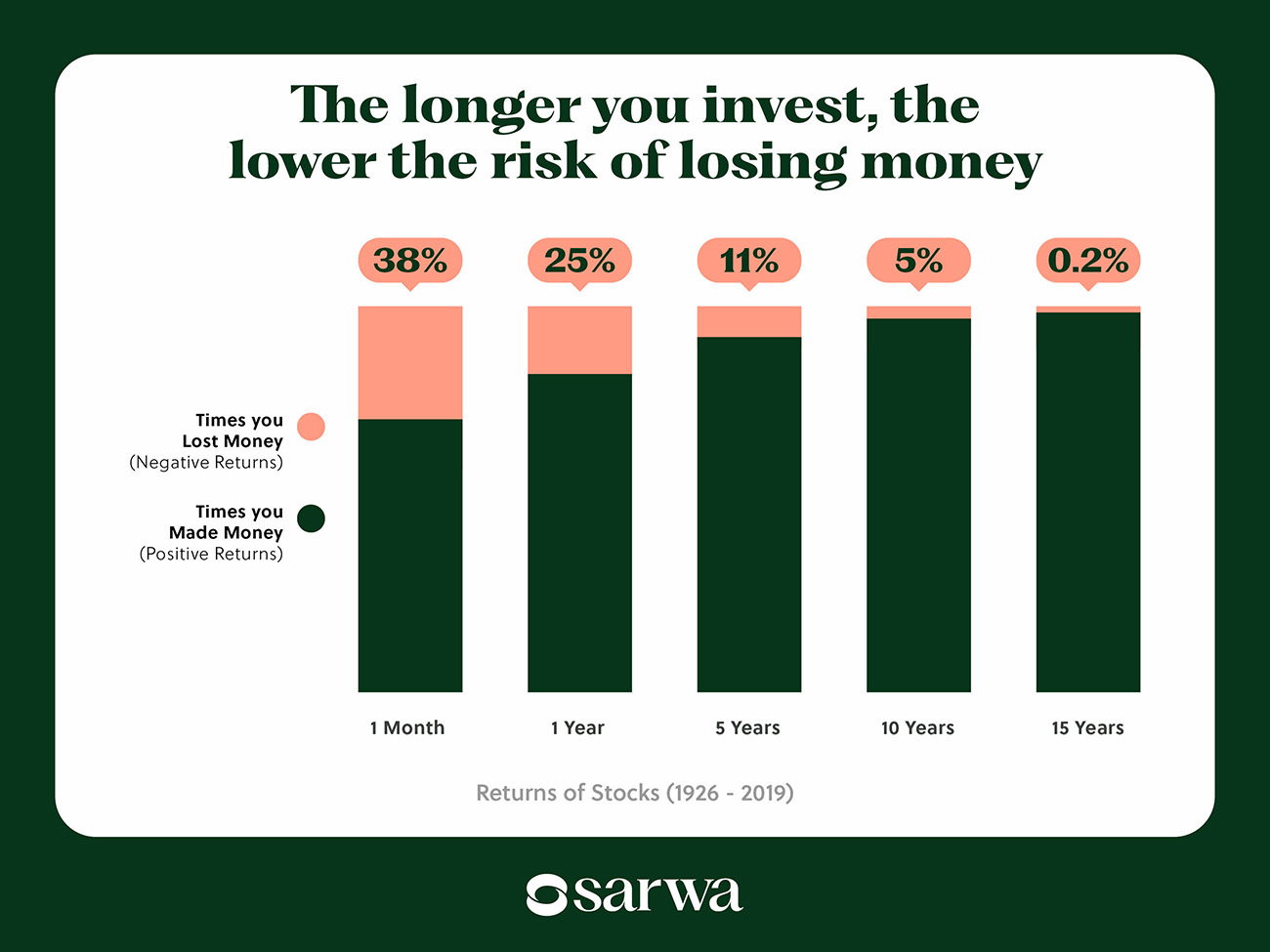
Thus, when you have a long time horizon, you can take more risks since over that long term, the probability of losing money is low.
2. Investment objectives
Your investment objectives are the specific goals you want to achieve by investing your money. These can include financial independence (gradually replacing your monthly salary), retirement, paying cash for a property, starting a business, leaving an estate for your children, etc.
There is usually a close relationship between investment objectives and time horizon. An investment account focused on paying cash for a property may require a shorter time horizon than one focused on leaving an estate for your children.
3. Risk tolerance
While risk capacity focuses on how much risk you should be willing to take on, risk tolerance concentrates on how much risk you are actually willing to take on. It deals more with the psychological and emotional ability to deal with the upturns and downturns of the financial markets.
Those with high risk tolerance don’t mind taking up riskier investments that provide higher returns. On the other hand, those with low risk tolerance may be willing to tolerate lower returns for the sake of lower risk.
When considering investment strategies, investors should find a sweet spot where there is an alignment between risk tolerance and risk capacity.
4. Current financial situation
When learning how to create an investment strategy, you should also pay attention to your current financial situation. Some strategies may be appropriate for monthly salary earners, while others may fit more with independent contractors or business persons with irregular earnings (large amounts one month and small amounts the following months).
5. Investment knowledge
Some investment strategies don’t require much investment knowledge, making them appropriate for beginners. However, those with the skills and time to research the market can take on more complicated strategies in the search for alpha (excess returns over a benchmark index).
6. Liquidity or capital availability
The amount you have to invest will also determine the appropriate investment strategy in some cases.
In actual practice, you can’t consider these factors in isolation, as will become clearer in the next section. You should consider every single factor before making the choice of investment strategy.
2. 8 investment strategies and who they are appropriate for
Before talking about each strategy, it is crucial to divide them into three categories. This is because you can combine multiple investment strategies across each of these categories.
The first category consists of active and passive (buy and hold) investment strategies. This category is about the frequency with which you have to make investment decisions.
The second category includes lump-sum investing, dollar-cost averaging (DCA), and market timing. These investment strategies relate to when you will deploy your money in the market. Should you deploy all your investable cash at the same time, spread it over a number of months or weeks, or wait for a dip in the market?
The third category comprises growth investing, value investing, and dividend-growth investing. These investment strategies cover the type of assets you select in your portfolio.
As said above, you can select a strategy from each of the three categories and combine them. You can be an active investor who embraces lump-sum and growth investing. On the other hand, you can be a passive investor who embraces DCA and value investing. In essence, the main task of the investor is to select a strategy in each category.
1. Active investing
Active investing is a strategy where an investor continuously takes multiple buy and sell decisions in a bid to generate alpha. In other words, instead of tracking the performance of a given benchmark index (say the S&P 500 Index), you seek to outperform it.
Mutual funds are a typical example of active investing. These are investment managers who make frequent portfolio management decisions in a bid to generate alpha. Many individual investors also take this approach.
Active investing has experienced a bit of a bad reputation as research continues to show that many mutual funds underperform their benchmark indices, even after charging high management fees.
Below is the percentage of US mutual funds that underperformed their indices across various time frames, as of June 2025, according to S&P Global, a global financial firm:
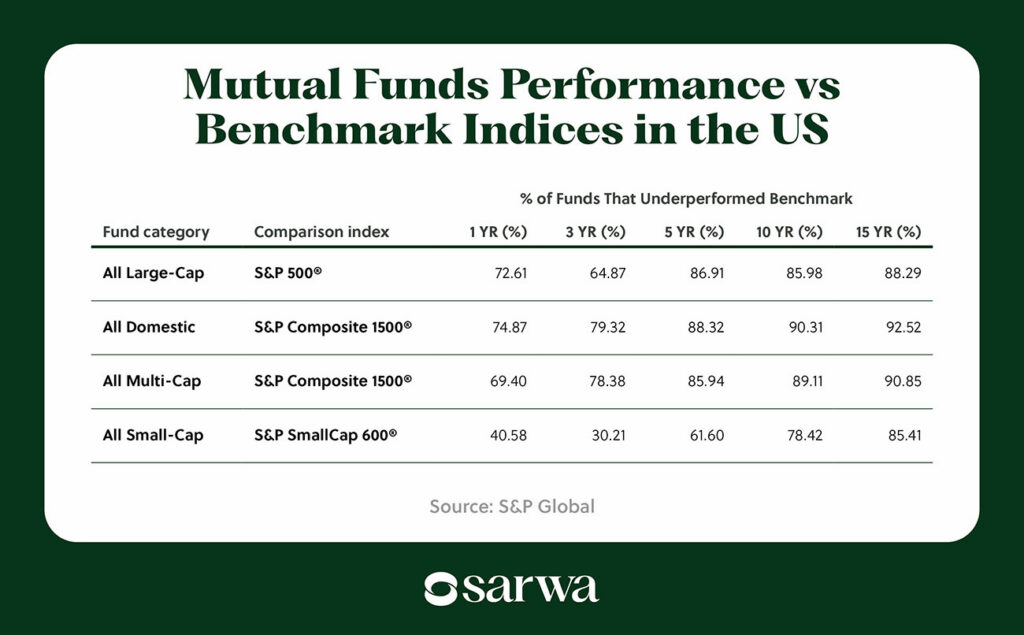
Source: S&P Global
If professional investors can’t do it, who can?
Yet, many active investors (professionals and otherwise) still beat the market. Moreover, active investing has the advantage of flexibility, with the possibility of using tax loss harvesting and other portfolio hedging techniques to minimize risk and tax.
Who is this strategy appropriate for?
Active investing is appropriate for those with sufficient investment knowledge to make buy and sell decisions. They go beyond stock market tips and tricks for beginners to combine expertise in stock market fundamentals and technical analysis.
Also, since diversification at the level of individual assets often requires a high investment outlay, active investing may be more suitable for investors with large investable cash. However, an active investor can decide to invest at the level of index funds and ETFs, though these don’t provide the same flexibility as individual assets.
Furthermore, active investing is appropriate for those with high risk tolerance and capacity. This is because active investors must be willing to deal with the high short-term volatility of individual assets in their portfolios.
2. Passive investing
The active and passive investing debate became popular when investors began to learn about the underperformance problem of mutual funds.
Since then, many investment experts have recommended that retail investors may be better off with passive investing.
Passive investing is about tracking the performance of a benchmark index by replicating its holdings and asset allocation formula instead of trying to beat it by adjusting its holdings and allocation formula. Index funds and exchange-traded funds (ETFs) are the darlings of passive investors.
Since passive investing is about tracking an index, they don’t make any buy and sell decisions until the index changes. By minimizing buy and sell decisions, passive funds incur and charge minimal fees (due to lower transaction costs) and generate very few taxable events (resulting in lower capital gains tax).
Passive investors (also known as buy-and-hold investors) are content to track the market because even when an active investor outperforms in terms of gross returns, the passive investor often outperforms by net returns (gross returns minus fees), which is what ultimately matters to the investor.
Who is this strategy appropriate for?
This buy-and-hold strategy is appropriate for investors who understand investing basics for beginners but don’t have the time or skills to research various investment options.
In terms of capital outlay, both big-money and small-money investors can use a passive investing strategy. For the latter, the diversification provided by each ETF or index fund means there is no need to spend a lot of money buying multiple individual assets.
When it comes to risk, passive investing is suitable for investors with low risk tolerance and capacity. However, it is also appropriate for those with high risk capacity but low risk tolerance.
This is because the performance of a passive fund tends to have less volatility since it typically contains multiple assets. Some assets will perform poorly, but that can be offset by those that do well. In contrast, an active investor’s investment portfolio can be disproportionately hit by the poor performance of a few overweighted companies.
Now that we have covered Category 1, you can consider where you fit in between active and passive investing based on your risk tolerance, risk capacity, investment outlay, and investment knowledge.
Next up: Category 2 investment strategies.
3. Lump-sum investing
A lump-sum investing strategy is one where you take all your investable cash and put it in the market immediately.
For example, if you have $20,000 to invest (maybe out of your monthly salary or a contract you just executed), you don’t divide it up into smaller amounts or wait for the prices of the assets you want to buy to get to a point. You enter the market with the whole thing immediately.
Why would someone follow this strategy? There is a simple two-word answer: compound interest. When you enter the market immediately, you have more time to benefit from compounding. And when you enter with all your investable cash, you start earning compound interest on the whole thing.
Our dollar-cost-averaging vs lump-sum investing research shows that lump-sum investing is the more profitable approach to market entry. “Lump-sum investing may generate slightly higher annualized returns than dollar-cost averaging as a general rule,” according to Morgan Stanley.
As shown below, lump-sum investing outperforms DCA 68% of the time, according to a survey of 1976-2022 market data by Vanguard, a global financial firm.
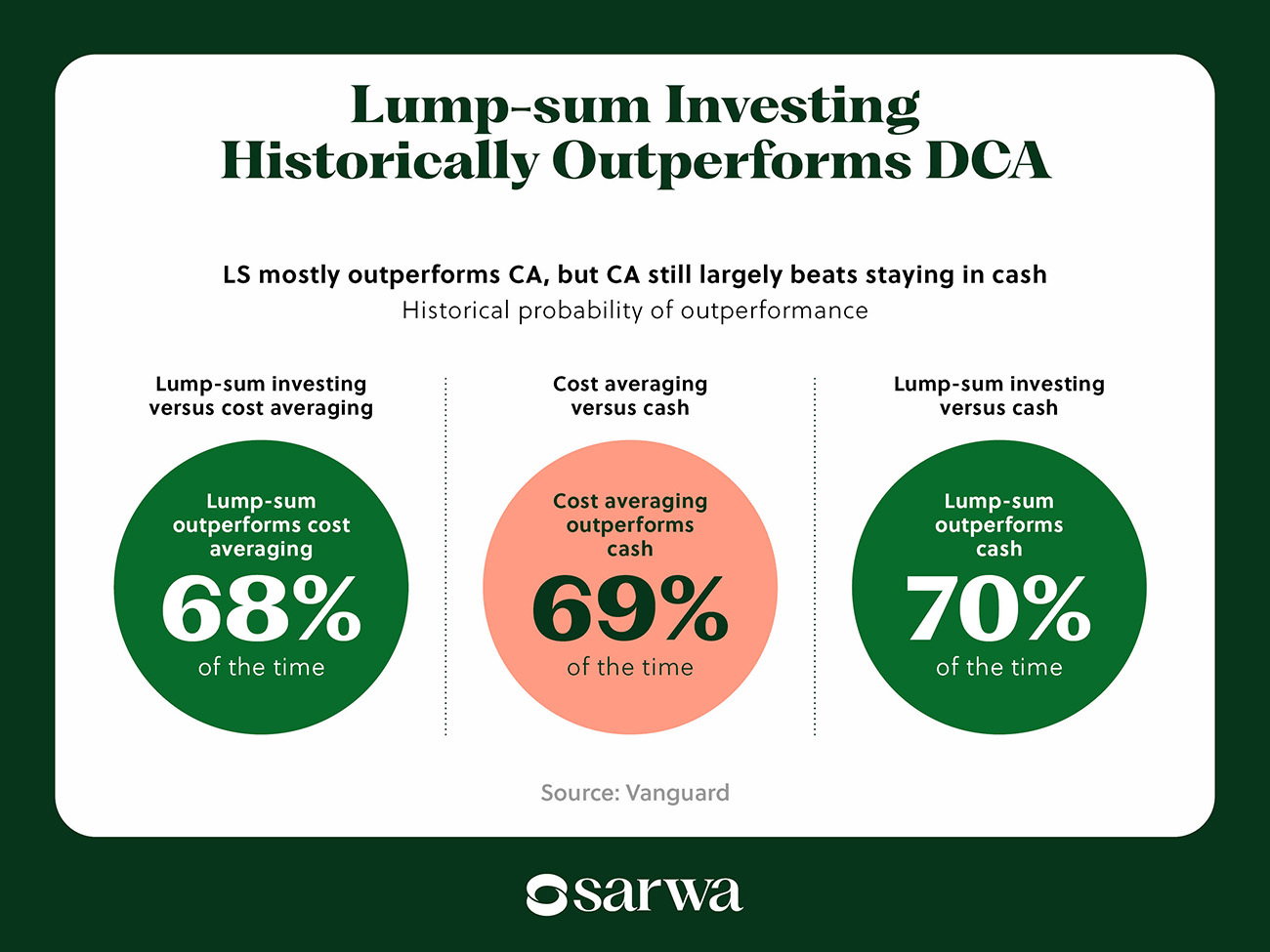
Source: Vanguard
Who is this strategy appropriate for?
You need to have a high risk tolerance to use this strategy. Imagine entering the market with your $20,000, and the market enters correction territory (prices falling by 10%-20% from a previous peak). Not many people can watch their portfolios experience those kinds of downturns, even if they know that the market rises more than it falls over the long term.
Secondly, lump-sum investing is often the preferred approach of those with monthly investment plans. If you receive your salary at the beginning or end of the month, you will typically take out the portion you are investing monthly and put it immediately in the market.
4. DCA
What is the DCA investment strategy?
It is an investment strategy that involves spreading out your investable cash over multiple periods. For example, someone who has $100,000 to invest can decide to invest $10,000 at the end of every month for the next 10 months instead of going all in at once (lump-sum investing).
Financial advisors have recommended DCA as a way to ease people into the realities of the market. Seeing your $10,000 lose 10% in value over three weeks, for example, is more manageable than seeing your $100,000 fall by the same percentage.
Also, DCA tends to be advantageous in both bull and bear markets. If you buy in a bear market, you get more shares ($10,000/$100 gives you 100 shares, but $10,000/$50 gives you 200 shares), and if you buy in a bull market, you can ride the wave.
Who is this strategy appropriate for?
DCA is appropriate for investors with low risk tolerance who can’t watch their large investment outlay fall in value.
Also, DCA is often the preferred strategy by business persons and independent contractors who don’t have a monthly income. When they make a large amount, they often prefer to spread it out over multiple periods.
5. Market timing
Have you heard about ‘buying the dip’? It is a familiar term among cryptocurrency traders. The idea is that by buying when the market is at the bottom, you can maximize your investment returns when there is a trend reversal to the upside.
If a market timer has $100,000, they won’t invest it immediately or invest a portion at every definite period. Instead, they will wait for the market to bottom out and then choose to invest the whole amount or a portion.
In reality, if you miss out on the best days of the market while trying to enter on its worst days, market timing becomes a disastrous approach.
Between 1957 and 2023, missing out on the best days of the market will cause the market timer to have an 800% lower return than the investor who stayed in the market throughout (best and worst days), according to Jonathan Dane, cofounder of Defiant Capital Group, an investment management firm.
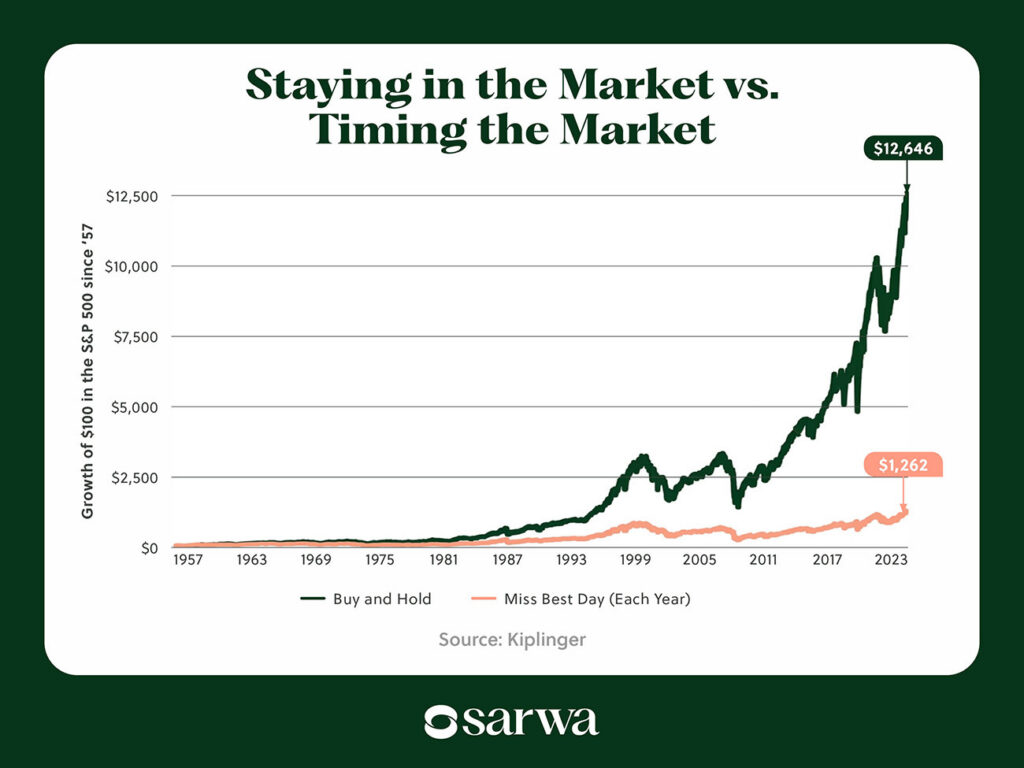
Source: Kiplinger
On the other hand, if the market timer avoided the worst days of the market and entered only at the bottom, they would have only made 30% extra.
Would you participate in a game where heads you get 800% lower returns and tails you get only 30% extra returns?
Similarly, no one can know when the market is at its dip. As they say, the dip can keep getting dipper. Also, market timing can lead to emotional investing in addition to being riskier and more expensive.
Of course, like active investing, many people time the market profitably.
Who is this strategy appropriate for?
Market timing is only appropriate for investors with high risk tolerance and capacity.
Also, though systematic investors can practice it, it is more fitting for those who don’t have a specific regular income.
That’s the end of Category 2. As said above, you can choose any of these three strategies that fit more with your risk tolerance and current financial situation.
Now we move to Category 3: growth, value, and dividend-growth investing.
6. Growth investing
Growth investing is a strategy where you invest in companies with a high or higher-than-average revenue and earnings growth rate. These are companies with a history of consistent growth and that have shown the capacity to maintain such high growth rates in the future.
Growth investors don’t usually care about the current share price of growth stocks (or the net asset value of a growth ETF). They don’t mind if the stock is currently overvalued since they believe that its future growth rate justifies such a high price. Instead, they are more focused on expected returns as a result of the company’s capacity to keep outgrowing its peers.
Who is this strategy appropriate for?
Growth investing is suitable for investors with a long time horizon who can ride out short-term fluctuations and stay invested for the longer term. This is because growth stocks are often in industries (healthcare, technology) that are quite responsive to macroeconomic conditions (especially interest rates) and thus beset with higher-than-average volatility.
Also, due to the high volatility, growth investing is suitable for investors with high risk tolerance.
Furthermore, many growth stocks don’t pay dividends as they prefer to reinvest back into the business to boost earnings growth. Thus, income-oriented investors who need regular dividends as part of their investment goals may not find growth investing appropriate.
7. Value investing
Value investors focus on selecting stocks that are currently trading below what they consider to be their intrinsic value. Some value investors like Warren Buffett will select only undervalued quality stocks, while some will buy any undervalued stock irrespective of fundamentals.
Deciding the intrinsic value of a stock is a subjective and potentially laborious process. Even the best experts will come up with different figures.
Nevertheless, investors have successfully used value investing to maximize returns on various individual assets.
Though it will seem that growth and value investing are only suitable for active investors, there are now ETFs that track either value or growth stocks, making the strategy fitting for passive investors as well.
Who is this strategy appropriate for?
Value investing is suitable for medium-to long-term investors since it sometimes takes time before the price of an asset equals its intrinsic value.
Regarding risk, value investing is in the middle of the road between growth and dividend-growth investing. Though one can trust in the market’s ability to recognize intrinsic value, it does not always work, and an asset can remain undervalued for a long time.
Income-oriented investors may not find value investing all that attractive since not all undervalued stocks pay dividends.
Finally, since valuation is a detailed process, only those with strong investment research skills can succeed at value investing, at least at the level of individual assets. Those without the skills can purchase ETFs that track only value stocks.
8. Dividend-growth investing
Dividend-growth investing is an investment strategy where investors focus on companies that consistently grow their dividends.
For some dividend-growth investors, the aim is to reinvest these consistently growing dividends to benefit from compound interest. For others, these dividends serve as an income source to meet some needs or wants.
Interestingly, companies that pay regular and growing dividends are considered stable companies. Thus, dividend-growth investing is also a defensive strategy that works well during negative market conditions (economic downturns and black-swan events).
Who is this strategy appropriate for?
Dividend-growth investing is appropriate for income-oriented investors who need regular income to meet some other goals or maximize compound returns.
Since dividend-growth stocks represent ownership in stable companies, it is especially appropriate for investors with low risk tolerance.
Finally, dividend-growth investing is often sold as a long-term strategy since it takes time for the snowball effect of growing dividends to significantly boost total returns.
How Sarwa supports your investment strategies
If you are a passive investor, you can register for Sarwa’s managed investment platform. Our wealth advisors will create a personalized portfolio of ETFs for you based on your investment goals, time horizon, and risk tolerance.
And if you choose to go the active investing route, you can create a portfolio for yourself on Sarwa Trade. There you will find multiple stocks, ETFs of many asset classes (including equities, bonds, cryptos, commodities, and real estate investment trusts), cryptocurrencies, and stock options to choose from.
Sarwa also supports lump-sum investing, DCA, and market timing, though we often discourage market timing for reasons already stated. Passive investors using lump-sum or DCA investing can automate deductions to their brokerage or investment account from their current or savings accounts at regular intervals.
You can also choose between growth, value, and dividend-growth investing. At the level of individual assets, we provide multiple stocks that fall under these categories. But if you go the passive route, you can purchase ETFs that follow any of the three strategies.
If you are still unsure of the path to tread, you can get professional advice from any of Sarwa’s wealth advisors.
What then are you waiting for? Sign up for Sarwa today to execute your preferred investment strategies and start building wealth for the future.
Takeaways
- The best investment strategy depends on your time horizon, risk tolerance, financial goals, current financial situation, capital availability, and investment knowledge.
- Each strategy (active, passive, lump-sum, DCA, market timing, growth, value, dividend) fits different investor types based on risk capacity, capital availability, among others.
- Investors often mix approaches, such as passive investing with dollar-cost averaging and dividend-growth investing, to balance risk and returns.
- Whether you prefer a hands-on or automated approach, Sarwa offers tools and portfolios to help you execute your chosen strategy confidently.