
Saving money is good, but on its own, it’s not enough to build actual wealth.
It’s only when you put your money to work by investing it that you can benefit from compounding interest and build real wealth from financial markets.
“How many millionaires do you know who have become wealthy by investing in savings accounts?” asked Robert Allen, the author of Cracking the Millionaire Code. “I rest my case.” Of course, the answer is zero.
About 75% of millionaires in the US attributed their wealth to consistent and regular investing over a long period, according to a national study of millionaires by Ramsey Solutions, a financial advisory firm.
But where should you invest your hard-earned money? With many people losing money to forex trading, failed businesses, and meme coins, among others, it is important to prioritize safe investment options in Dubai.
In this guide, we will consider how to invest money in the United Arab Emirates by highlighting tested and trusted UAE investment opportunities that can help you create wealth.
We’ll cover:
- How to start investing: Setting your finances in order
- Where to invest money in the UAE: 8 Safe investment options to consider
- How to invest money in the UAE: 4 principles for beginners
- Creating an investment plan
Do you want to learn more about the principles of successful investment? Subscribe today to Sarwa’s Fully Invested newsletter for regular updates about investing best practices.
1. How to start investing: Setting your finances in order
Before you can build wealth through investing, you need to set the right foundation through sound financial planning.
“The building blocks of growing wealth are creating a gap between your income and expenses and then investing the surplus in something that produces income or appreciates in value over time,” according to Elie Irani, an IT professional and personal finance enthusiast, in a podcast episode with Sarwa.
After surveying some studies about millionaires, Gulf News also concluded that the secret to wealth is creating multiple income streams (investment income, rental income, interest income, royalty income, capital gains, business profits). And this begins with using your salary to fund other investments.
Before considering the second part – investing the surplus – let’s spend some time helping you set your finances in order so you can create a gap between your income and expenses.
Have a budget
The best way to gain control of your finances is to have a budget. “A budget is telling your money where to go instead of wondering where it went,” according to John Maxwell.
One popular budgeting rule that we also recommend is the 50/30/20 rule. This requires that you spend 50% of your monthly income on your needs (rent or mortgage, clothing, utility bill, etc.) and 30% on your wants (entertainment, hobbies, eating out, etc.). The remaining 20% is your monthly savings.
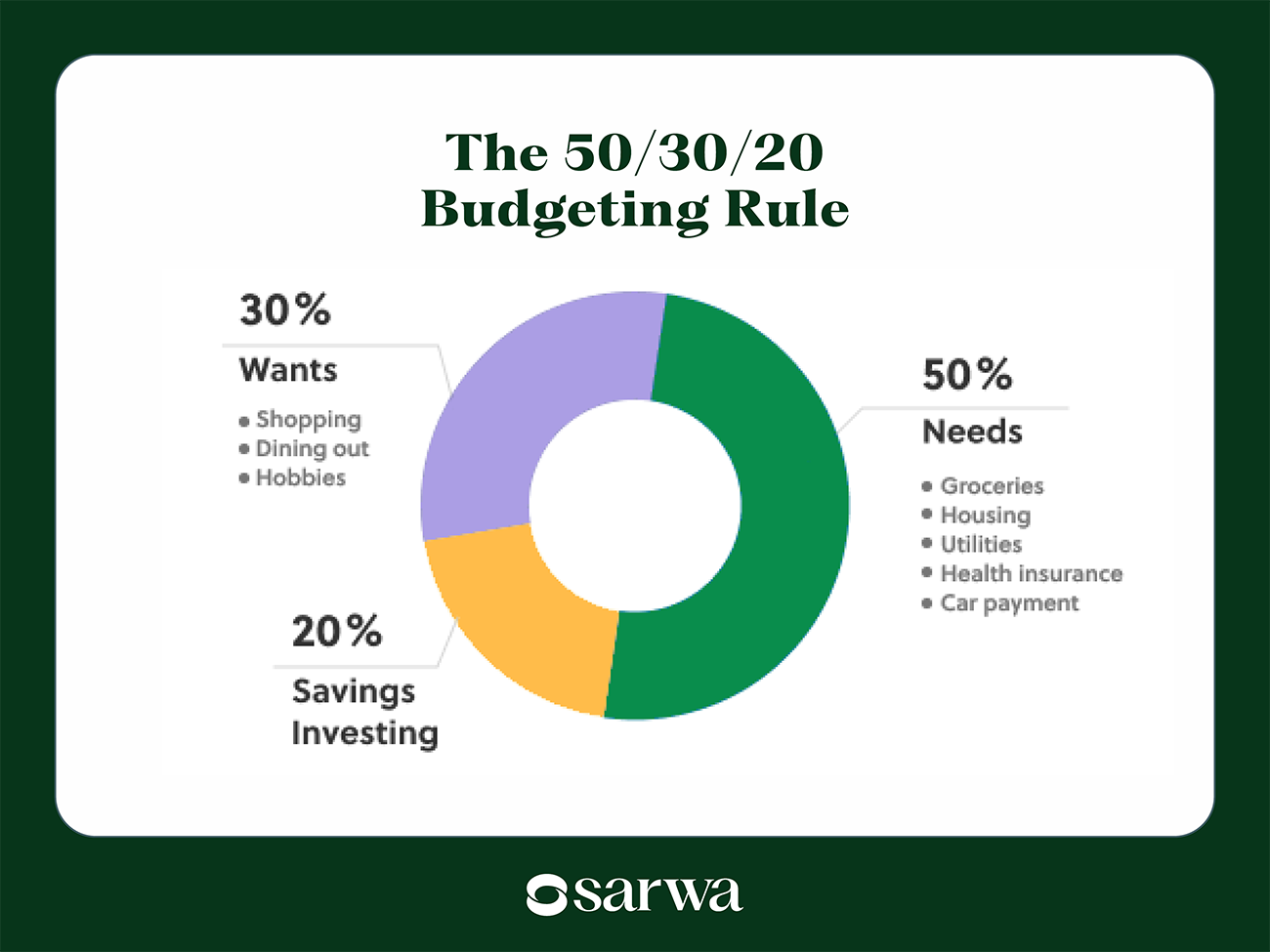
This 20% is significant, as one of the primary aims of budgeting is to ensure that you spend less than you earn.
Stick to your budget
It is not enough to have a budget; you need the discipline to stick to it.
The best way to stick to your budget is to save before you spend. One of Warren Buffett’s quotes is that you should not “save what is left after spending, but spend what is left after saving.”
You have also probably heard the phrase “pay yourself first,” which was popularized by George Clason in his book, “The Richest Man in Babylon.”
If you keep your savings in the same account you keep the money you spend on needs and wants, then the temptation is always there to overspend.
To counter this, it is best to first remove your savings and put them in your investment account while you develop the discipline to stick to the amount you have allocated for your needs and wants.
Create an emergency fund
Before considering the best investments in the UAE, you should learn how to start an emergency fund.
An emergency fund is money set aside to cater for unplanned and unexpected expenses resulting from job loss, medical crises, natural disasters, and unexpected repairs, etc.
If you start investing without an emergency fund, you may end up liquidating your investments when emergencies arise. Or you may have to rack up credit card debt (or any other form of consumer debt) and pay exorbitant interest on such.
An emergency fund is a better alternative. Financial advisors often advise that such an account should have up to six months’ worth of your living expenses (needs and wants).
For emergency funds, the primary factor is the ease of access (liquidity) rather than the interest rate. Put your emergency funds where you can access them when (and only when) emergencies arise.
Fortunately, with a platform like Sarwa Save, you can enjoy the best of both worlds – high interest rate and accessibility (you can withdraw your money anytime you want it).
2. Where to invest money in the UAE: 8 Safe investment options to consider
If you implement the three strategies above, then you already have a consistent and regular source of investment capital: 20% of your income.
But how should you invest this money?
There are three preliminary points we need to make here:
- Prioritize time-tested investment options in the UAE: Financial scams are everywhere! Maybe you have been approached by money doublers who promised to double your money in days or those who said they would make you a millionaire in weeks.
Instead of being captivated by such get-rich-quick schemes, you should focus on investment assets that people have successfully used to build wealth over centuries.
- Focus on financial assets: While starting your business is an option to build wealth, the entrepreneurial journey is uncertain (10% of them fail in the first year and 90% fail in the long run, according to Exploding Topics, a trend monitoring website) and often requires a large capital outlay (which beginners don’t have) to achieve decent success.
Therefore, as Irani advised in the podcast quoted above, we will focus on the financial markets since they have “low entry points” (no entrepreneurship skills needed), which makes them available to the average Joe.
- Look beyond the UAE: Though you are in the UAE, the different ways to invest money available to you are not limited to its shores. Many investment apps in the UAE connect you to the global market so you can explore more investment opportunities.
For example, we all know that some of the most successful companies are listed on the US stock market. Why miss out on such companies by focusing exclusively on the UAE?
So, then, what are the safe investment options in Dubai for Emiratis and expats?
A. Stocks
A stock is a portion of a company’s capital that individual and institutional investors can own.
When you purchase a company’s stock, you own a portion of the company. There are two ways to make money from stock ownership:
- Dividends: Most companies decide to share a portion of their net income with shareholders. This portion is called a dividend. The company pays a dividend based on the number of shares you hold. Most companies pay dividends every three months.
- Appreciation in the stock price: For our purposes (long-term investing), the appeal of stocks is how their prices can rise over the years. For example, 5 years ago, a share of Nvidia Corporation (NVDA) sold for $13.26. At the time of writing, it is trading at $177.82, for a total return of 1,241.03%.
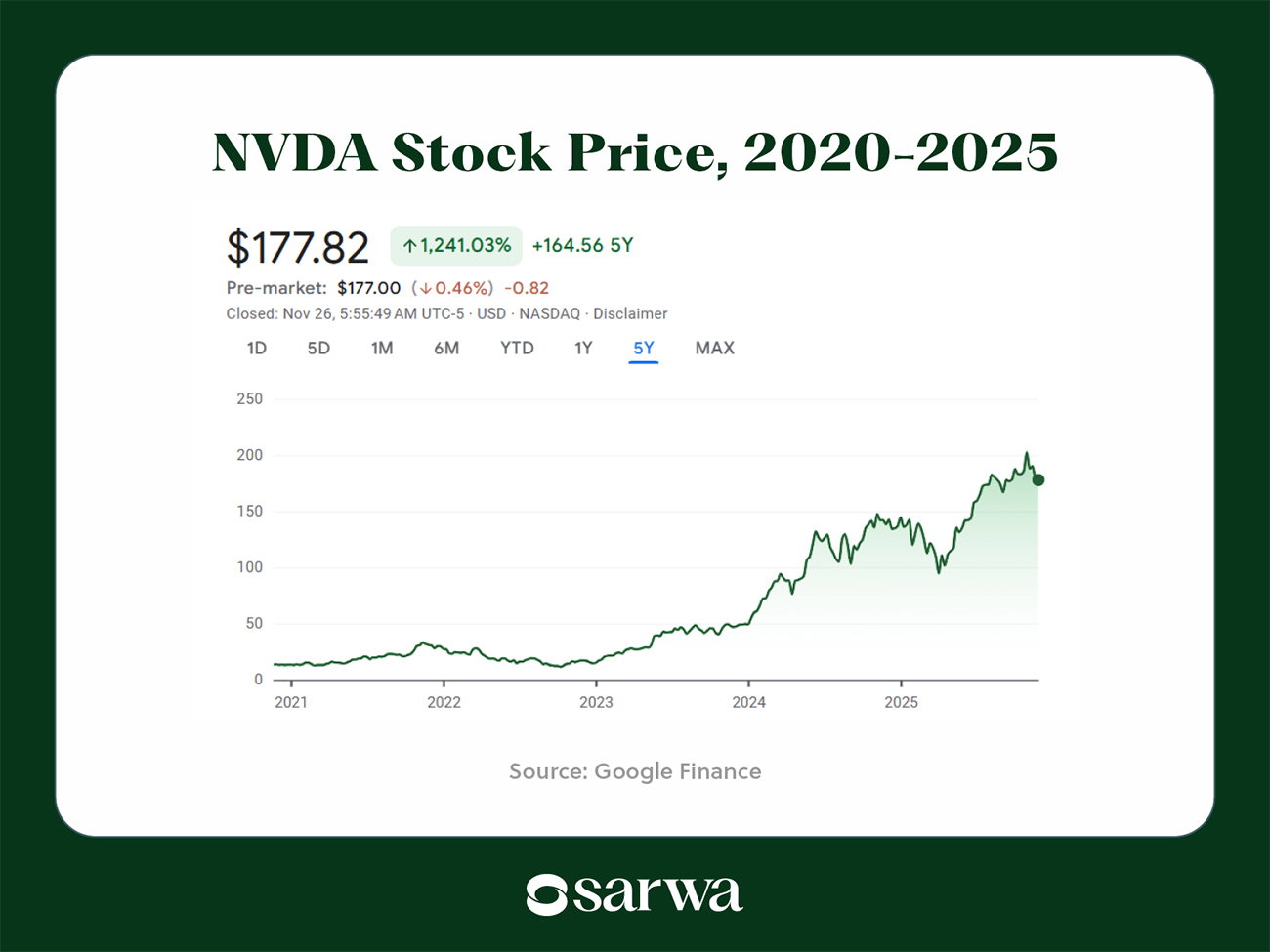
Source: Google Finance
If you had invested $1,000 in NVDA 10 years ago, that money would be worth $125,010 by now. If you sell, you can pocket capital gains of $124,010 tax-free.
Of course, not all stocks will provide such massive returns, and we will return to that in a bit.
How to invest in the stock market
To invest in the UAE stock market, you will need a stockbroker, who will provide you access to any of the three stock exchanges in the UAE — Dubai Financial Market (DFM), NASDAQ Dubai, and Abu Dhabi Securities Exchange (ADX).
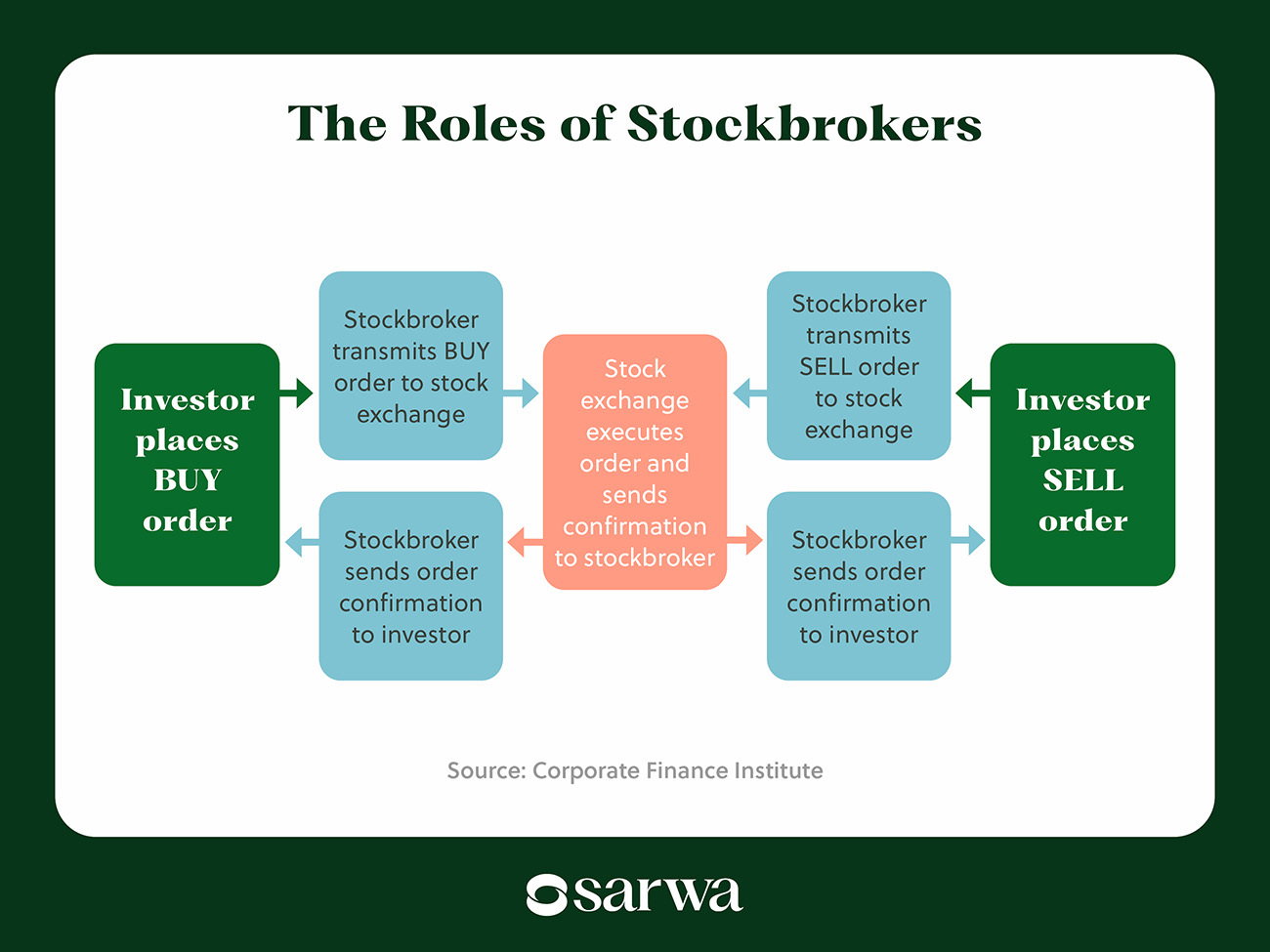
A stockbroker is an intermediary that facilitates transactions between buyers and sellers on stock exchanges. As an individual, you cannot buy or sell stocks in the UAE stock market (or any others) without a broker. Therefore, learning how to invest money in the UAE stock market begins with choosing the right broker.
Source: Corporate Finance Institute
Any broker operating in the UAE will give you access to any of the three UAE stock exchanges above.
However, if your financial goals require you to buy foreign US stocks like Apple, Google, Facebook, etc., you will need a broker that can grant you access to international stock exchanges like the New York Stock Exchange (NYSE) and NASDAQ.
But why should you learn how to buy US stocks in the UAE?
It is no secret that the largest and most successful companies are in the US. This should not be surprising since the US remains the wealthiest country in the world.
Consequently, the US stock market remains the greatest source of wealth for stock investors. Furthermore, it is the largest in terms of capitalization, transaction volume, and the number of listed companies.
Since we aim to build wealth, focusing on the US stock market is a no-brainer.
B. Bonds
A bond is a debt instrument that governments and corporations use to raise money. For our purpose, there are three types of bonds:
- Corporate bonds: Company issuances
- National bonds (Treasury bonds): Federal government issuances
- Municipal bonds: Local government, state, city, and local community issuances
You can make money from bonds in two ways:
- Interest payment: Bond issuers make interest payments to bondholders twice a year. Unlike stocks, bonds have a fixed interest rate.
- Growth in the bond value: You can also make money when a bond grows in value. When the interest rate drops and new bonds are issued at lower interest rates, your bond’s value (which was issued at a higher interest rate) rises. When the stock market is down, many people turn to bonds, sending their prices up.
Bonds are generally issued for a long period.
Unlike stocks that you can own forever (provided the company does not repurchase them), you can only hold bonds for a predefined period.
Bonds provide a consistent stream of income for a certain number of years, such as 10-year and 20-year bonds. You can also earn on them by selling them at a higher price before maturity.
Bonds are considered less risky compared to other investments and are typically used as a counterbalance to stock investments.
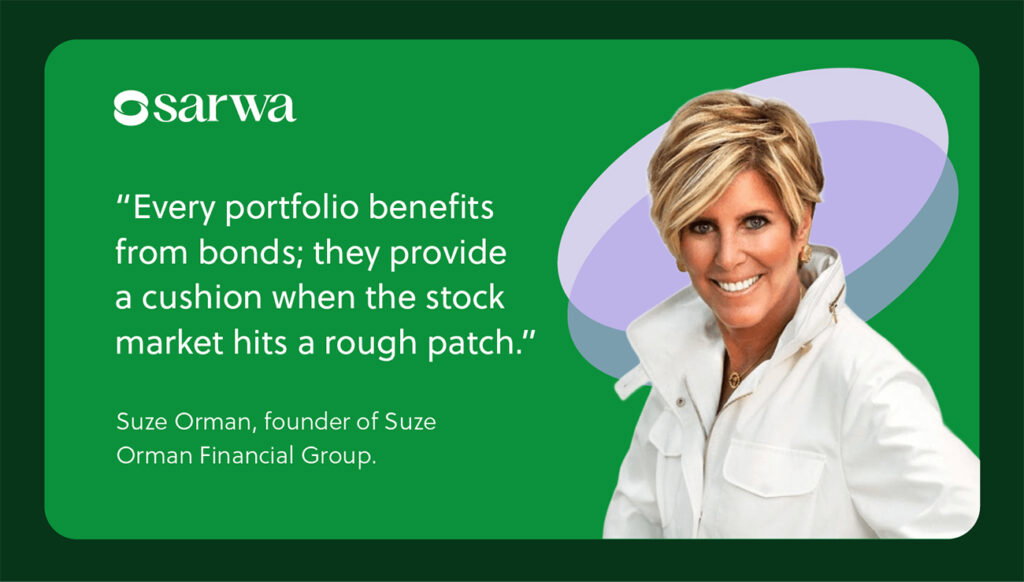
“Every portfolio benefits from bonds; they provide a cushion when the stock market hits a rough patch,” says Suze Orman, founder of Suze Orman Financial Group.
However, their return is not as high as stocks: less risk equals smaller returns.
When it comes to investing in corporate bonds, investors should conduct diligent research to understand if the company has a low-risk profile, as defined by bond rating agencies.
How to invest in the bond market
The same broker that provides access to stocks would help you buy and sell bonds.
If your focus is on GCC bonds, a local broker would do. But if you want to explore foreign bonds, investment apps in the UAE like Sarwa will give you the required access.
C. Mutual funds
Those without the time or skills to conduct thorough stock market fundamental and technical analysis can purchase stocks and bonds through mutual funds.
A mutual fund (also known as an investment fund) pools money from various individual investors and invests it in stocks, bonds, and other fixed-income securities under a fund manager’s supervision.
The fund manager is an expert who understands the market and has the experience and skills to choose individual stocks or bonds.
By pooling a large sum of money from different individuals, mutual funds offer diversification as they can invest in more companies.
When someone purchases a mutual fund, they own a portion of the mutual fund rather than the individual investments (the mutual fund operates as a company). In other words, the shareowner doesn’t own a portion of the stocks or bonds the mutual fund purchases; instead, they own a portion of the mutual fund itself.
Within a mutual fund, there are equity funds, fixed-income (debt) funds, balanced or hybrid funds (they invest in both equities and fixed-income securities), and specialty funds (they invest in a particular sector, industry, or theme).
How do mutual funds make money?
- Dividend/interest: When the stocks or bonds the mutual funds purchase pay dividends or interest, they distribute them to the funds’ owners according to the number of shares they own.
- Appreciation in the mutual fund’s value: The price of a mutual fund increases as the value of the stocks and bonds it possesses increases. Also, the price of a mutual fund rises as the demand for it increases.
As the mutual fund grows, the value of the share price grows.
There are different types of mutual funds based on how they trade and the investments they purchase.
Based on trade, there are:
- Open-end mutual funds: These are mutual funds you can buy or sell throughout the year. You can add more units or sell the ones you have.
- Closed-end mutual funds: You can only sell closed-end mutual funds at a specific maturity date. You hold it until maturity.
Based on the philosophy of investing, there are:
- Passively-managed funds: Passively-managed mutual funds (also known as index funds) attempt to match the performance of the market instead of trying to beat the market. They don’t buy and sell their investments frequently or incur higher management fees or taxes.
An index is a basket or umbrella of securities. For example, the S&P 500, which is the most popular stock market index, is a basket that contains the 500 largest US stocks.
An index fund seeks to mirror the performance of an index by investing in the securities that make up that index. That is, it is content to earn the same returns that the index earns.
Consequently, an index fund only buys and sells securities when the composition of the underlying index changes.
- Actively-managed mutual funds: Actively-managed mutual funds attempt to outperform the market. They usually have an index that serves as a benchmark for their performance. Instead of tracking this index, they seek to achieve a higher return.
To achieve this aim (which they rarely do), they frequently buy and sell stocks, bonds, and other investments that constitute the fund. Unlike index funds that buy and sell only when an index’s composition changes, mutual funds buy and sell regularly in pursuit of better returns.
Consequently, they incur higher fees, making them more expensive.
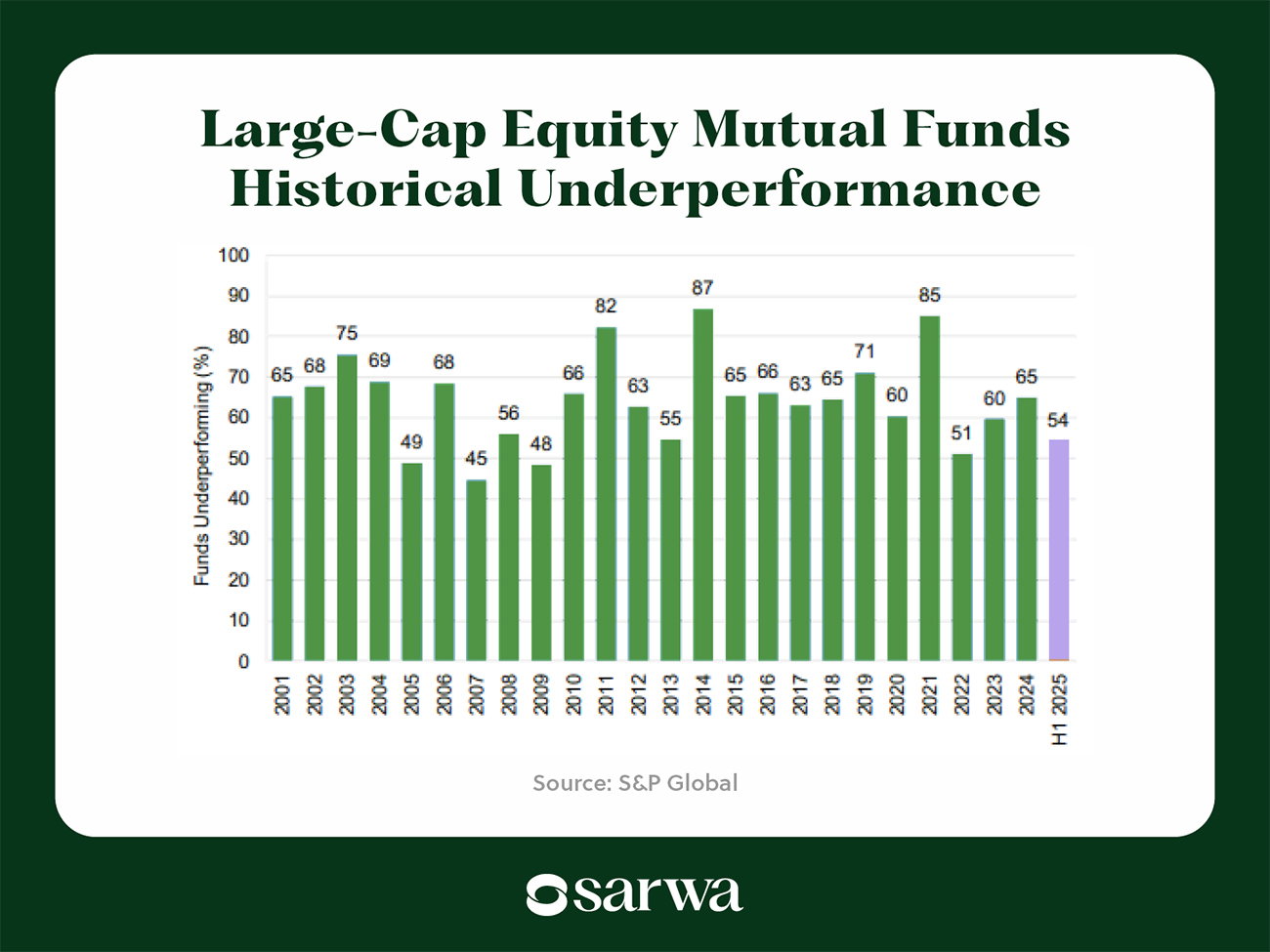
Also, the higher risk they expose investors to is not always compensated for with higher returns, given how active funds have underperformed their benchmarks in recent years.
As the chart below shows, a large percentage of large-cap equity mutual funds in the US have underperformed their benchmarks over the past 24 years. In 21 of these 24 years, the percentage of those who underperformed has exceeded those who tracked or outperformed their benchmarks.
Source: S&P Global
Similarly, active mutual funds are not transparent; they value flexibility more than transparency.
Therefore, it’s difficult to know the investments an active mutual fund is holding at a particular time. What they hold today can change before you wake up the next day.
As we will still see, understanding the difference between active and passive investment is essential to your wealth-building journey.
How to find the best mutual fund in the UAE
Mutual funds in the UAE can be broadly classified into two categories: local and international.
Local mutual funds invest in local securities available on DFM, ADX, or NASDAQ Dubai. Thirty-three such mutual funds are currently listed on the Securities and Commodities Authority (SCA) website.
In addition, there are international mutual funds that invest in securities in international exchanges like the NYSE and NASDAQ.
If you prefer passively-managed mutual funds, you can also buy local and international index funds in the UAE through your local broker or an international investment app.
Whether local or international, you must consider these four factors to determine the best mutual fund in the UAE:
- Investment objective: The first thing is to consider the investment objective of the fund and see if it aligns with yours. Here, an understanding of your risk tolerance is important. The risk a mutual fund is taking to achieve its investment objective should not be more than what you are comfortable with.
- Past performance: Consider how the mutual fund has performed (returns) in past years in comparison with similar funds. If other funds with similar objectives are outperforming it or if its returns are declining year-on-year, it is not good for you.
- Expense ratio: The expense ratio is the portion of a mutual fund’s assets under management (AUM) that goes to its operating expenses. When the value of a mutual fund increases, not all of that added value goes to investors; some of it goes to the operating expenses. Consequently, the higher the expense ratio, the lower the profit you can expect to earn on your investment. Hence, for similar investment objectives and past performance, choose a mutual fund with a lower expense ratio.
- Customer service: Customer service includes the ease with which you can contact the fund’s management, the reporting analytics they provide, and how much they try to be accountable and responsive to you.
The best mutual fund in the UAE will have investment objectives similar to yours, competitive performance (returns), a competitive expense ratio, and excellent customer service.
D. ETFs
Exchange-traded funds (ETFs) are today’s go-to example of popular passive investments, which makes them one of the safest investment options in Dubai.
Over the past decade, ETFs have become one of the most popular investment vehicles for diversification. By owning a share of one ETF, an investor gains exposure to numerous stocks or bonds within that basket.
For example, the iShares Core MSCI EAFE ETF (IEFA) tracks stocks in developed markets, excluding the US and Canada. It currently invests in 2,604 stocks across Europe, Australia, Asia, and the Far East.
When an investor purchases a share of IEFA, they are purchasing exposure to large-, mid-, and small-capitalization market equities across these regions.
While a single ETF offers a lot of diversification, purchasing many ETFs offers even more.
For example, an investor can purchase an ETF of US stocks together with an ETF of international stocks, an ETF of global REITs, an ETF of UAE stocks, and an ETF of US bonds.
Apart from the diversification each ETF offers, you enjoy more diversification (and less portfolio risk) by combining various ETFs that spread across broadly different markets.
Instead of buying individual stocks, bonds, or REITs (more on this latter), investors can use ETFs as part of a strategy to gain more diversification, and at a fraction of the cost.
ETFs vs. Mutual Funds
Since diversification is the same motive behind mutual funds, how then do they differ from ETFs?
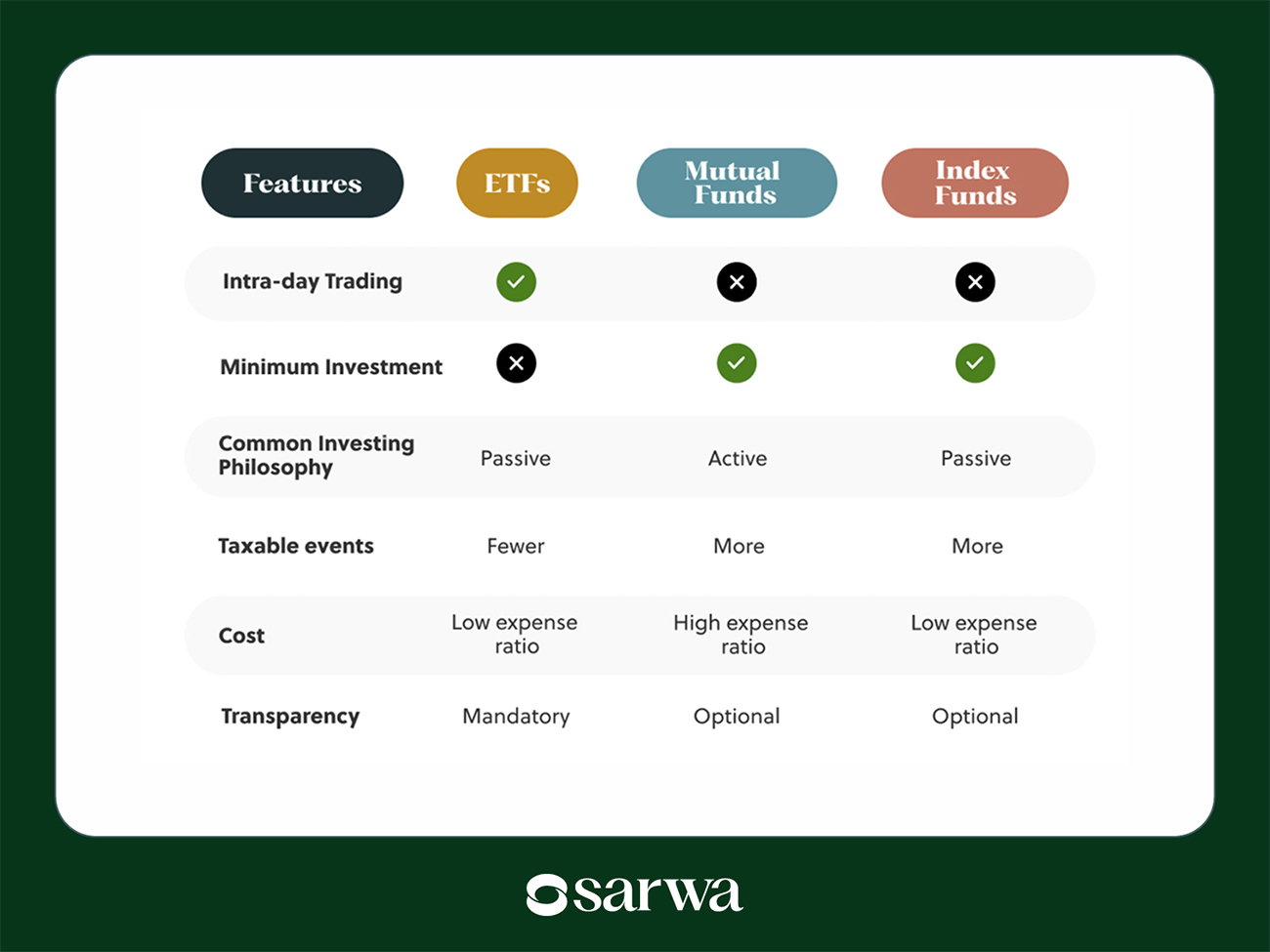
There are at least five differences between the two:
- Transparency: ETFs are mandated by law to publish the details of their holdings at least every quarter. Mutual funds don’t have such a mandate. While many ETFs publish the details of their holdings daily, most mutual funds prefer not to publish such details as a way to protect their investing strategy (trade secret).
- Minimum investment requirement: Most mutual funds will require you to invest a minimum amount before you can get started. However, ETFs allow you to start with just a single share or even a fraction of a share. This makes ETFs the best option for a small investment in Dubai and the best investment in the UAE for expats who are just finding their feet.
- Investment philosophy: While mutual funds are actively managed, 90% of ETFs are passively managed, according to Franklin Templeton, an investment management firm.
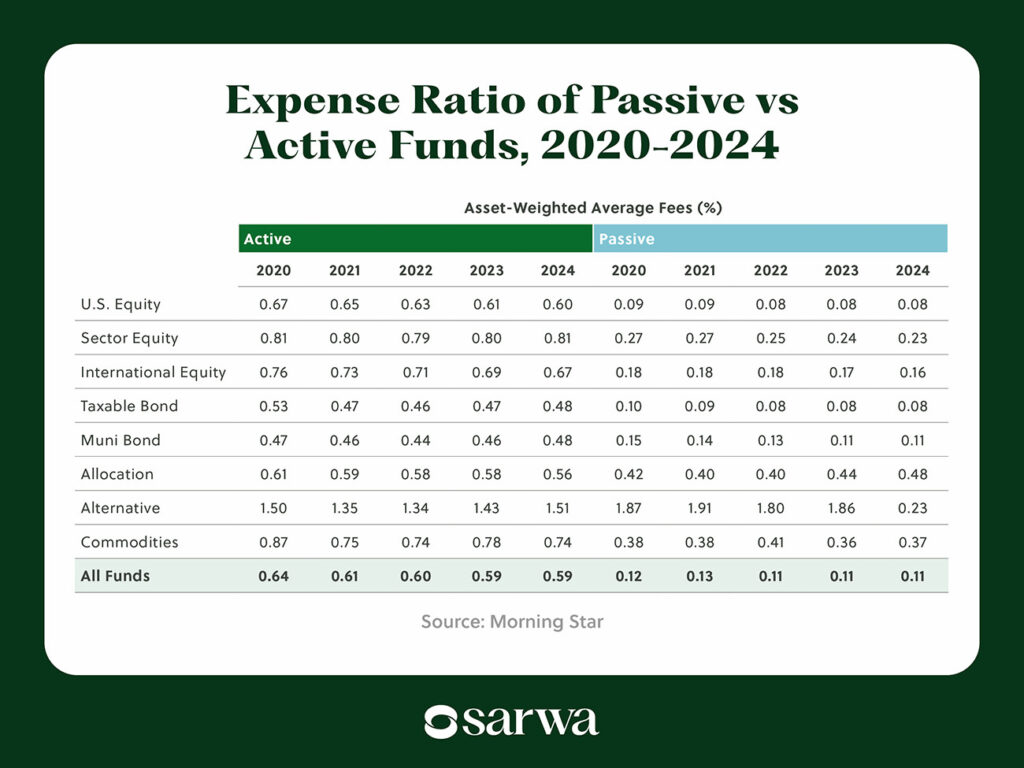
- Expense ratio: Since mutual funds are actively managed, they incur higher management (operating) fees. Though their expense ratio has been falling, it is still higher than that of ETFs, as seen in the chart below:
Source: Morning Star
- Trading time: While you can only buy mutual funds at the end of trading hours, you can buy ETFs any time during trading hours. The advantage of this is that you can liquidate your ETFs at any time without waiting for trading to close for a day.
ETFs vs. Index Funds
So why invest in ETFs instead of index funds, since they are both passively managed?
Below are some of the advantages of ETFs over index funds:
- ETFs are cheaper than index funds: Though they are both passive investments, ETFs are cheaper than index funds, according to Mirae Asset, an investment management firm.
- ETFs are more liquid: You can buy ETFs throughout the day on an exchange, while you need to wait till the end of a trading day to purchase index funds.
- ETFs are more transparent: The price of an index fund is decided when the fund manager calculates the fund’s Net Asset Value (NAV) at the end of the day.
The price of an ETF is directly determined by the market forces of supply and demand. Investors thus know the current price at every point in time. In this sense, ETFs are democratic, according to Mark Fitzgerlad, Head of Product Specialism at Vanguard Inc., a global financial firm.
- ETFs also offer better diversification: Investors today have at their disposal a widening range of ETFs that offer more diversification than ever before. There are innovative ETFs that invest in niche products and industries.
Some ETFs focus on emerging and developed markets. There are global and international ETFs as well as industry-specific ETFs. The large range of ETF products out there will help you achieve better diversification than index funds.
How to invest in ETFs
The ETF market in the UAE is not yet developed.
There are a few options, like the Chimera S&P UAE Shariah ETF and the Chimera S&P UAE UCITS ETF, that are listed on ADX. You can access them through your local broker.
Sarwa also has an ETF that invests in multiple UAE stocks.
If you want international exposure, your options are limitless. Sarwa has hundreds of ETFs tracking the US market, developed markets, and emerging markets.
E. Real Estate Investment Trusts (REITs)
Many rich people have accumulated wealth in the real estate market. The Dubai real estate market is especially booming, as reported by Gulf News, and many investors from across the globe are chipping in.
But is investing in real estate safe?
Not if you are a beginner.
Real estate requires a huge capital outlay, diversification is hard (you need a lot of money), managing tenants is difficult, many fees can eat into your profit, and the market is illiquid (not easy to quickly turn properties into cash without selling at a discounted price).
Thus, while we recognize that real estate, in general, is one of those time-tested investments, we believe that beginner investors should start with REITs.
REITs are stocks of companies that purchase real estate properties (Equity REITs) or provide mortgage facilities to real estate investors (Mortgage REITs).
REITs are bought and sold like the shares of any other company. Instead of buying properties and managing them, investors hold the shares of companies that are investing in the market (including mortgage lenders).
REITs earn money through dividends and appreciation in the price of the REIT. They often pay regular dividends (they pay most of their income as dividends), providing a stable income source to the investor.
They are great options for those looking for how to invest money to make money and want to gain exposure to real estate without the risks of owning a property.
How to invest in REITs
Since the UAE is a thriving real estate market, you can find some REITs listed on exchanges like ADX, DFM, and Nasdaq Dubai. These include Emirates REIT, ENBD REIT, and Al Mal Capital REIT, among others. You can invest in these through your local broker.
For international exposure, you can buy individual REITs or a REIT ETF through any investment app that offers access to the global market.
Buying individual REITs has the same downside as buying individual stocks, and buying REIT ETFs has the same advantage as buying any ETF.
F. Gold
We cannot talk about where to invest money in the UAE without mentioning gold.
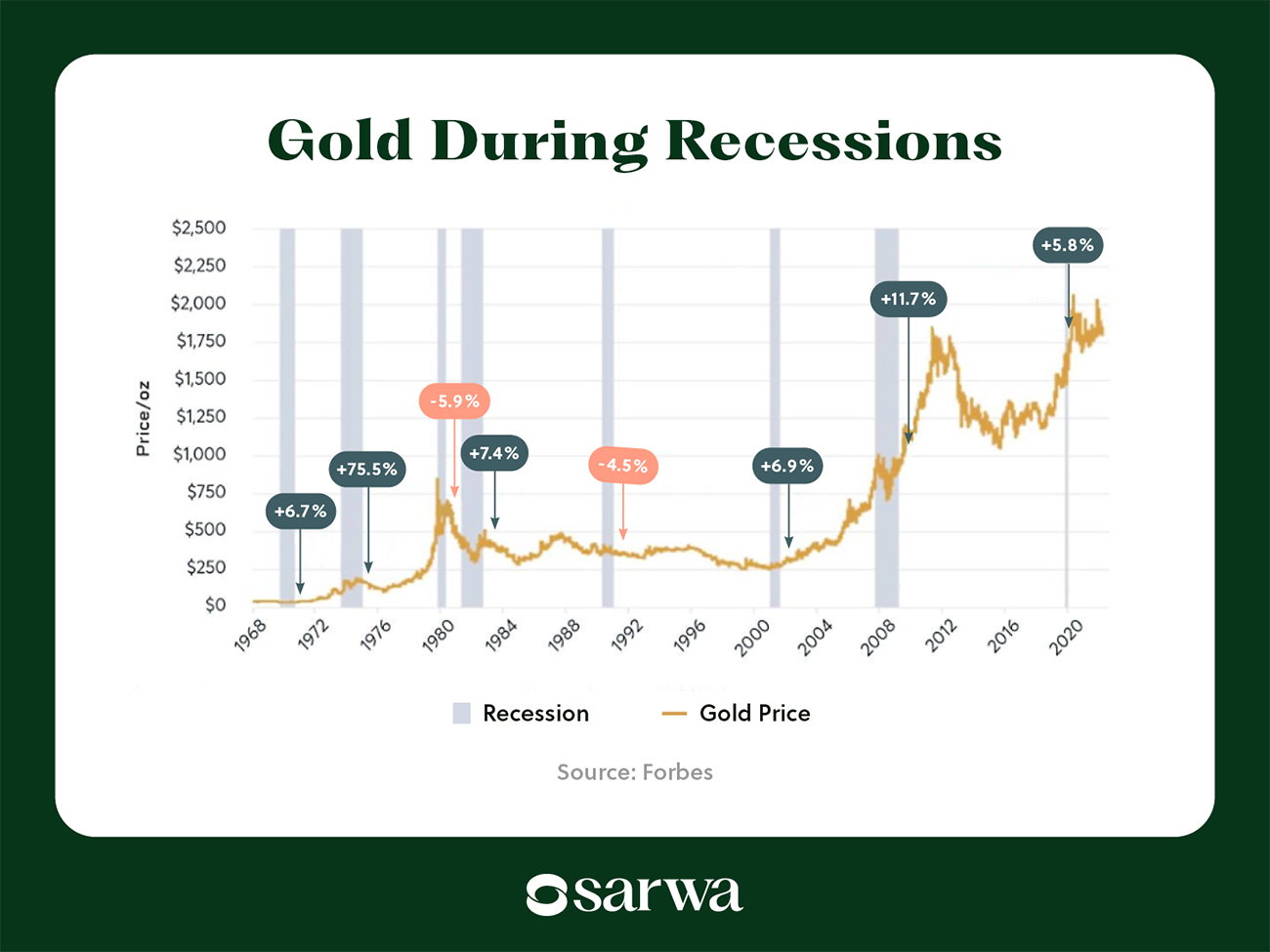
Gold has been considered a store of value because its supply is limited and cannot be increased arbitrarily. Many investors run to it as a safe haven during deflationary, inflationary, and recessionary periods.
It proved its value as an inflation hedge during the 1970s but did not replicate the results in the 1980s, the 1990s, and the period following the COVID-19 pandemic.
However, it proved its value during the deflation of the Great Depression, and it has outperformed the S&P 500 index in six of the eight recessions between 1973 and 2020, according to Forbes.
Source: Forbes
This tendency for gold to perform well during recessions (when stocks tend to underperform) has made many investors embrace it (in the same manner as bonds) as a way to diversify their portfolios.
How to invest in gold
There are five options to explore if you are considering how to invest in gold in the UAE:
- Gold bullion: You can buy physical gold in the form of gold bars and coins at Dubai Gold Souk, jewelry stores, and other specialized bullion houses. However, note that physical gold is often illiquid, more expensive, and requires safe storage.
- Gold stocks: These are stocks of gold mining companies. Since their revenue depends on the price of gold, buying them is a way to gain exposure to gold. However, gold stocks only provide indirect exposure, and picking individual stocks is always difficult for beginners.
- Gold mutual funds: These are mutual funds that invest in gold mining stocks. Though they offer diversification, they are expensive and also offer only indirect exposure to gold.
- Gold mining ETFs and gold exchange-traded commodities (ETCs): Gold mining ETFs are funds that invest in gold mining stocks.
On the other hand, gold ETCs (also called ETFs in some quarters) invest in physical gold. As an investor, you own a share of the fund’s assets but won’t be required to take delivery of physical gold. You will receive a cash payment when you sell your shares.
You can purchase both gold mining ETFs and ETCs on platforms like Sarwa.
- Gold derivatives: These are gold futures and options. They offer leveraged exposure to gold for experienced investors. You can buy gold derivatives through the Dubai Gold and Commodities Exchange.
G. Silver
Is investing in silver a good idea?
Though gold is the more popular commodity, silver has also proven its mettle as an investment asset.
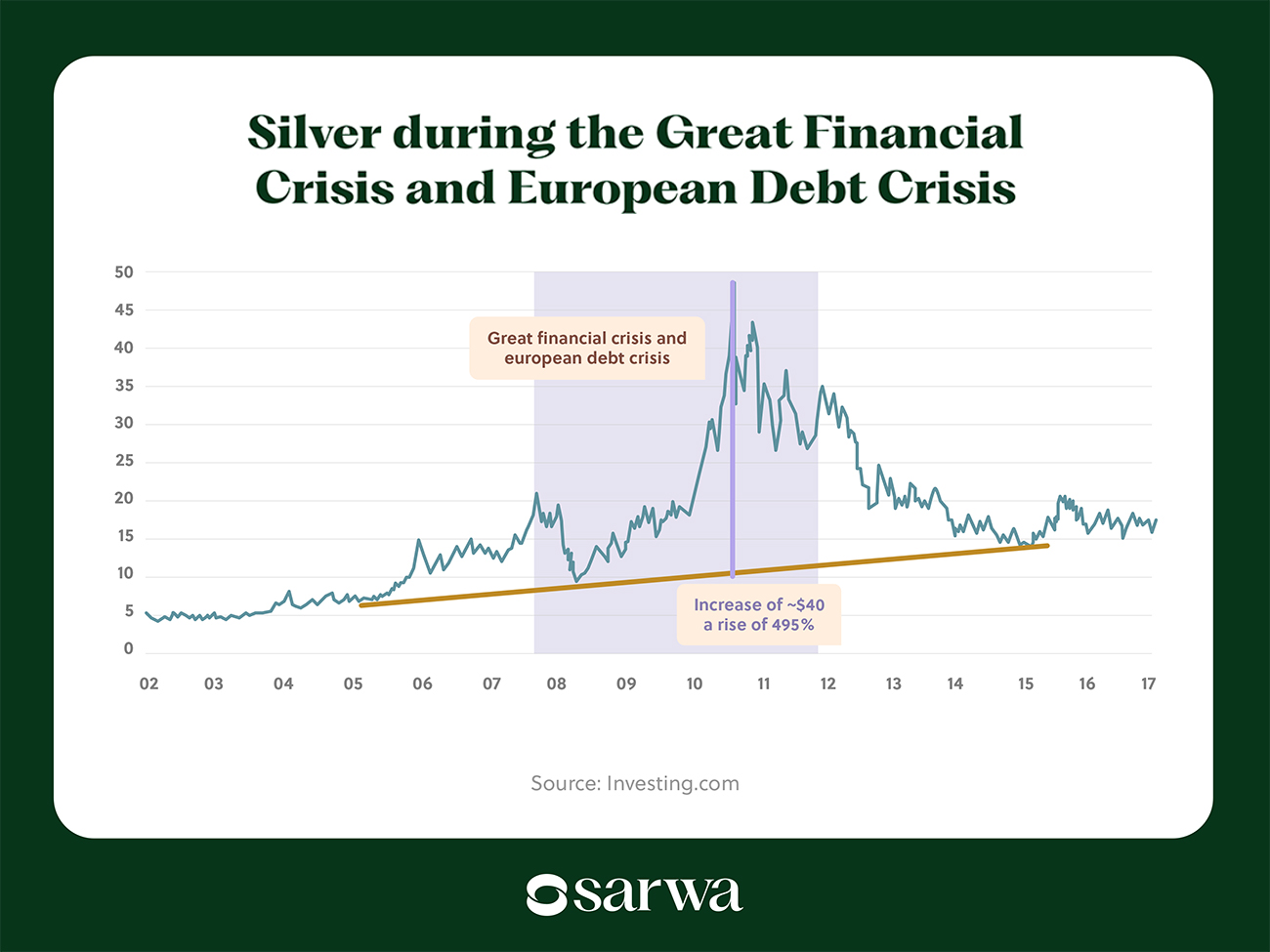
Like gold, silver provides a safe haven during economic downturns and financial crises. For example, silver went up by 495% during the Great Financial Crisis and the European Debt Crisis, according to a study by Capitalight Research referenced by Investing.com.
Also, silver has acted as a store of value, an inflation hedge, and a portfolio diversifier.
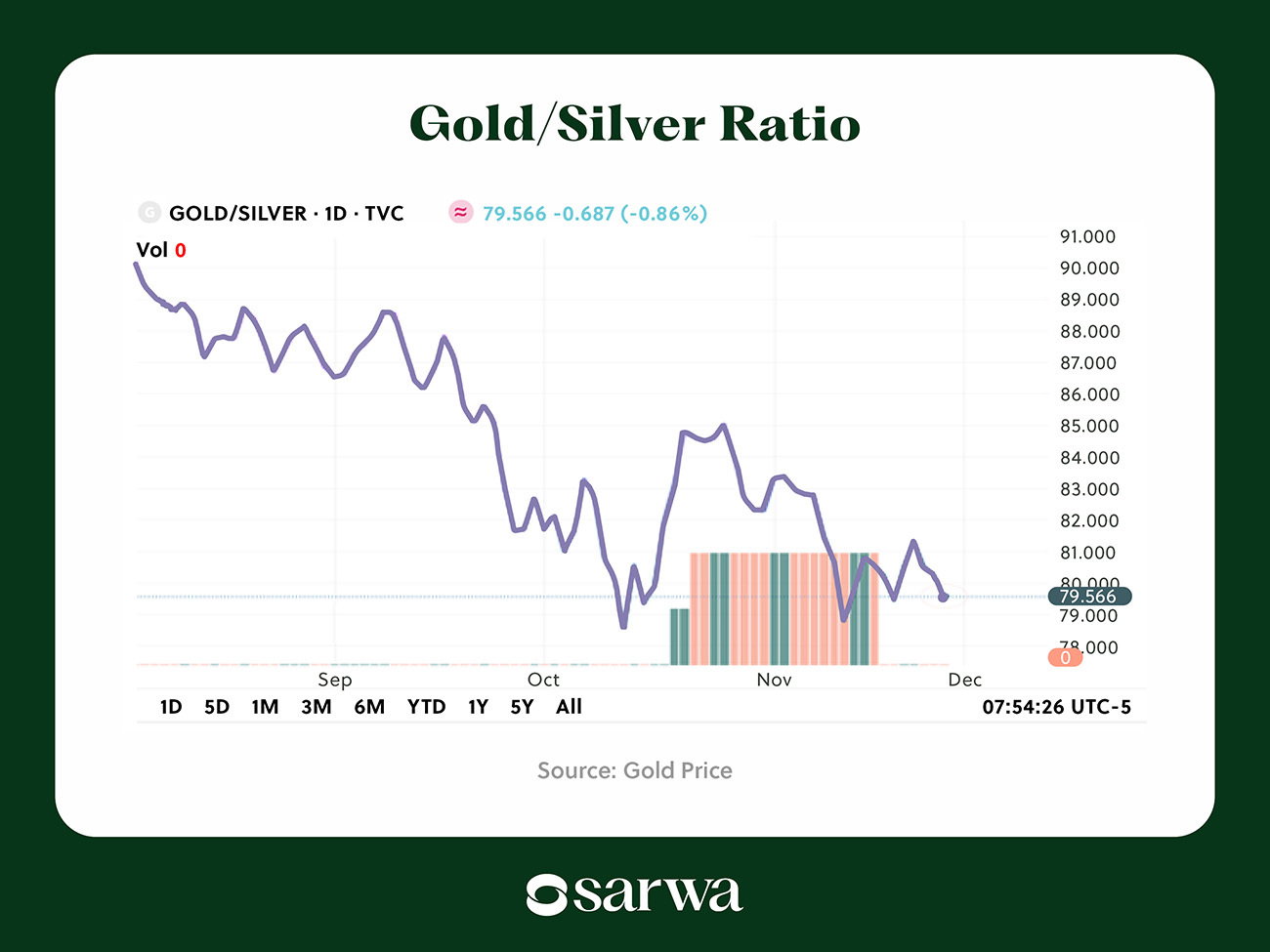
Given that the gold/silver ratio is currently higher than its historical average (between 50-60, according to Macro Trends), many analysts are forecasting that silver could outperform gold in the short to medium term.
Source: Gold Price
Similarly, silver’s industrial demand has been growing due to the global focus on artificial intelligence and renewable energy. Given the long-term prospects of these themes, silver’s long-term prospects are bright.
How to invest in silver
You can invest in silver the same way you invest in gold: silver bullion, silver stocks, silver mutual funds, silver ETFs, and silver derivatives.
H. Bitcoin
Since cryptocurrency has been a harbor for scams and cyber attacks, does it make sense to have it on a list of different ways to invest money in the UAE?
The answer is yes for one reason: bitcoin.
Like gold, bitcoin has a limited supply, which makes it a good store of value, a potential inflation hedge, and an option for diversification.
Bitcoin’s ability as an inflation hedge was only theoretical, given that inflation and inflation expectations had been low during the period of bitcoin’s rise.
However, many academic researchers have shown that bitcoin was a good inflation hedge during the inflationary period that followed COVID-19, even though its role as a safe haven (like gold) is still unproven.
Bitcoin also proved its usefulness for diversification when it maintained an almost zero correlation with the stock market between 2012 and 2020, according to data collected by Morning Star, a financial services firm.
However, recent data shows that the correlation is increasing, making the role of bitcoin as a diversification tool more doubtful.
What about the significant returns that bitcoin seems to provide? While high returns are good, we must also consider the risk (often measured as volatility) associated with a crypto like bitcoin.
Yet, bitcoin has a higher risk-adjusted return (measured by both the Sharpe ratio and the Treynor ratio) than both gold and stocks, according to a study published by KNE Publishing, an open-access publisher in Dubai.
In other words, even after adjusting for risk/volatility, bitcoin still outperformed gold and stocks. What this means is that investors need to see bitcoin’s role in a portfolio as a return enhancer rather than a risk reducer.
Given the mixed nature of these results, it is left to you to decide if Bitcoin should be part of your portfolio or not.
How to invest in bitcoin
You can purchase bitcoin on popular global crypto exchanges like Binance, Coinbase, and Bybit. This method requires that you create crypto wallets and manage your wallet addresses.
Since 2024, traditional financial institutions have been issuing bitcoin ETFs. This is a simpler way to gain access to the cryptocurrency.
You can also directly purchase bitcoin and other cryptocurrencies on a platform like Sarwa. This method does not require wallets and addresses, as Sarwa holds custody of the crypto assets under its regulated entity.
Having considered where to invest money in the UAE, the next question that arises is: “What is the best investment in the UAE?”
The simple answer is that there is no single best investment.
As we have seen, some of these UAE investment opportunities provide high potential returns (stocks, bitcoin) while others help to reduce risk (bonds, gold, silver). Some, like REITs, also help investors generate high passive income.
Thus, your investment plan in the UAE should be creating a portfolio that adequately combines these safe investment options in Dubai.
3. How to invest money in the UAE: 4 principles for beginners
Now that we have considered where to invest money in the UAE, let’s continue our consideration of how to invest money in the UAE by looking at four key principles that you must embrace as a beginner investor.
Long-term investing
While there is nothing wrong with short-term trading of stocks or ETFs (or any other asset), long-term investing is the best way for beginners to build wealth in the financial markets.
Though the figures differ (1%, 4%, 5%) depending on who is writing about it, it is a fact that only a tiny percentage of traders make money consistently after brokerage fees.
As Irani said (recollecting what he read from Tony Robbins, life coach and business strategist), trading is not for the average Joe and 95% of people are better off investing in passive index funds (passive ETFs in our case).
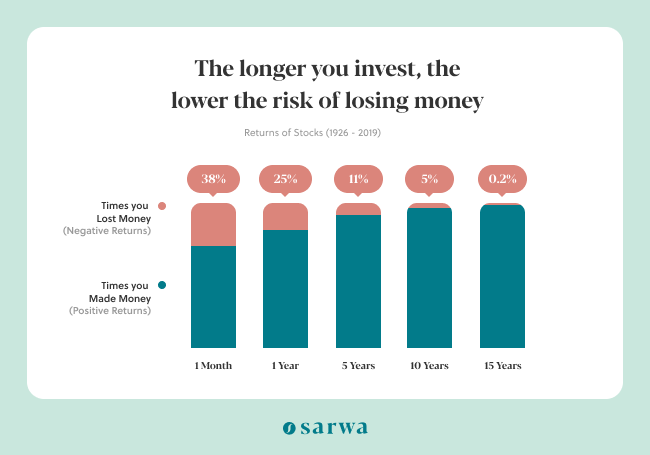
This is because with investing, the longer the time you spend in the market, the lower your chances of losing money, and the higher your chances of making money.
This is the conclusion from a study by Morning Star that analyzed stock market performance between 1926 and 2019. The result is presented in the following chart:
Warren Buffett once said that the first investing rule is not to lose your money, and the second rule is to remember the first. Long-term investing is a great way to follow this rule.
But the good news is not that you don’t lose money, it is that the money you don’t lose keeps working for you month in, month out, year in, year out until a ripple turns to a wave and a wave into a tidal wave.
It’s no surprise then that the self-made millionaires we encountered pointed to steady and consistent long-term investing as the secret to their success.
For example, if you invest AED 10,000 at the end of every month for the next 10 years in a portfolio that generates an 8% annual return (that compounds every quarter), you will have AED 1,824,086.73 at the end of year 10.
Diversification
Diversification remains one of the core principles for anyone looking at how to make good investments.
You have probably heard the popular investment adage, “Don’t put all your eggs in one basket.”
It’s not enough to know where to invest (the best investments in the UAE); knowing how to combine these various investments in a way that minimises risk and maximises return is crucial to building wealth over the long term.
Putting your eggs in different baskets — that is, diversification — ensures that your overall investment risk is reduced. To understand how this risk reduction occurs, we’ll need to first review a bit about correlation and risk.
Correlation, risk, and diversification
When two investments are positively correlated (correlation coefficient is greater than 0), they move in the same direction — when one falls, the other falls with it. If this positive correlation is perfect (correlation coefficient is +1), the direction and magnitude of fall is the same — a 20% fall in Asset A causes a 20% fall in Asset B.
In contrast, if two assets are uncorrelated (the correlation coefficient is 0), a fall in one asset does not affect the other.
Even better, if the two assets are negatively correlated (the correlation coefficient is less than 1), a fall in one asset will cause the other to rise. If the negative correlation is perfect (the correlation coefficient is -1), a 20% fall in one asset will cause the other to rise.
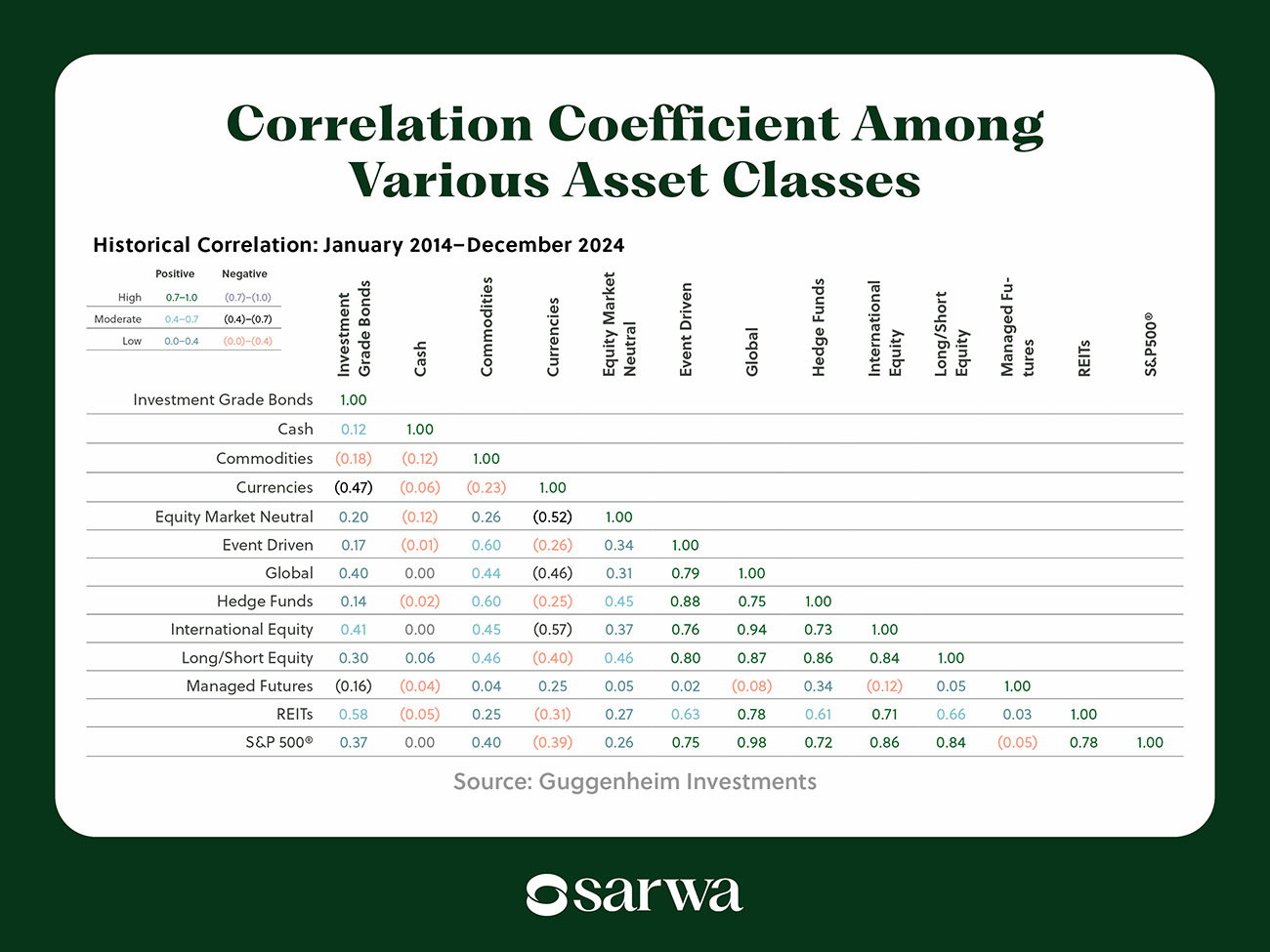
In reality, negatively correlated and uncorrelated assets are rare. What is more common are assets with low correlation to one another (a correlation coefficient lower than 0.5). Low correlation ensures that two assets in a portfolio are not moving too closely together, and this helps reduce the risk of the entire portfolio.
Four types of diversification
There are four different ways to achieve diversification:
- By asset class: Here, you need to combine different assets with low correlation to one another to reduce risk. The chart below shows the correlation coefficient among different asset classes between 2014 and 2024.
Source: Guggenheim Investments
- By industry: This involves investing in industries with low correlation to each other. Putting all your eggs in one industry can be dangerous when that industry goes through a purple patch. When your assets are spread across industries, you are safe.
- By markets: While developed markets provide stability, emerging markets provide high returns. Combining the two can help you achieve a balanced risk-return profile.
- By market cap: Large-cap, mid-cap, and small-cap companies often have different characteristics that make them uncorrelated or negatively correlated to each other. Diversifying in those three categories can help further reduce portfolio risk.
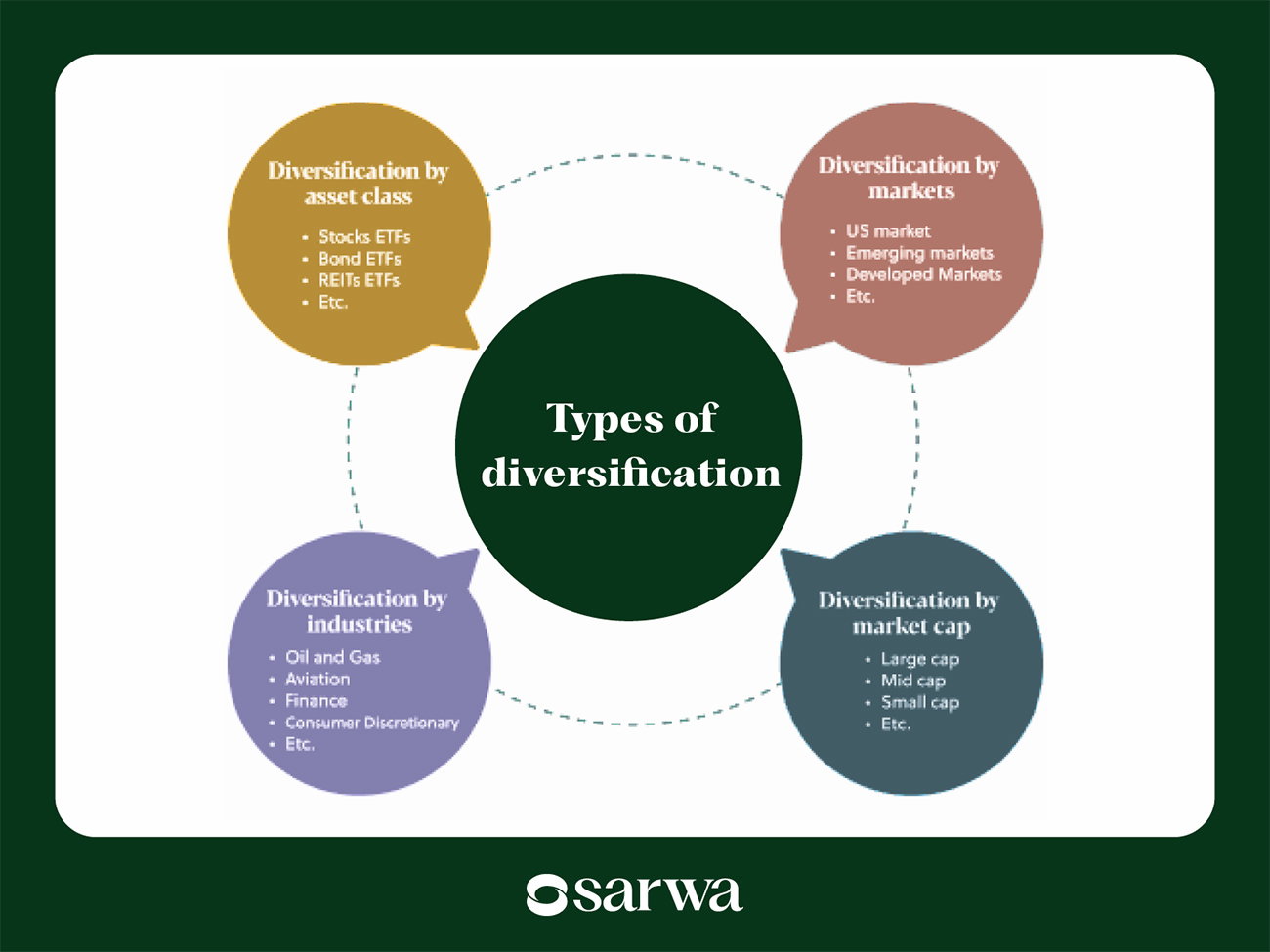
In summary, the best investment in the UAE is a diversified portfolio that contains different assets with low correlation.
[To learn more about the importance of diversification, read “Learning The Importance of Portfolio Diversification Can Prevent Huge Loss. Here’s Why.”]
Passive vs. active investment
Passive investing has at least three advantages over active investing: low cost (fees and taxes), long-term focus (instead of market timing), and less risk.
On the other hand, the advantage that active investing was supposed to deliver — outperforming the market — has been hard to come by.
As we saw in the S&P Global report, many mutual funds still underperform their benchmarks.
If mutual funds, with the diversification they enjoy and the expert investment managers they employ, find it hard to outperform the market, it is even more difficult for individual investors.
Therefore, a smarter approach is to track the performance of the market through passive investing while enjoying lower fees, risk, taxes, and a long-term focus that is not disturbed by the noise of the stock market.
Confident in the superior value of passive investing, Warren Buffett in 2007 placed a $1 million bet with the managers of Protege Partners that a passively managed index fund would outperform a collection of hedge funds over the next decade. When the results came in, the S&P 500 Index Fund had returned 7.1% and the hedge funds 2.2%. The message, in Elie Irani’s words, is: “don’t try to outsmart the market.”
Interesting, right? In addition to all the advantages listed above, you have the bet of the Omaha Oracle himself as an added confirmation of the value of passive investing.
In summary, passive investing is the best way to invest money in Dubai. This is why we advise investors to buy passively-managed ETFs.
Using managed investment platforms
Though passive investing is simpler than active investing, there are still many decisions to make:
- How many ETFs should you buy?
- How should you diversify your portfolio?
- What portion of your investment capital should go to which assets?
We can summarize all of these questions under the portfolio structure. This refers to how you divide your money among various investments.
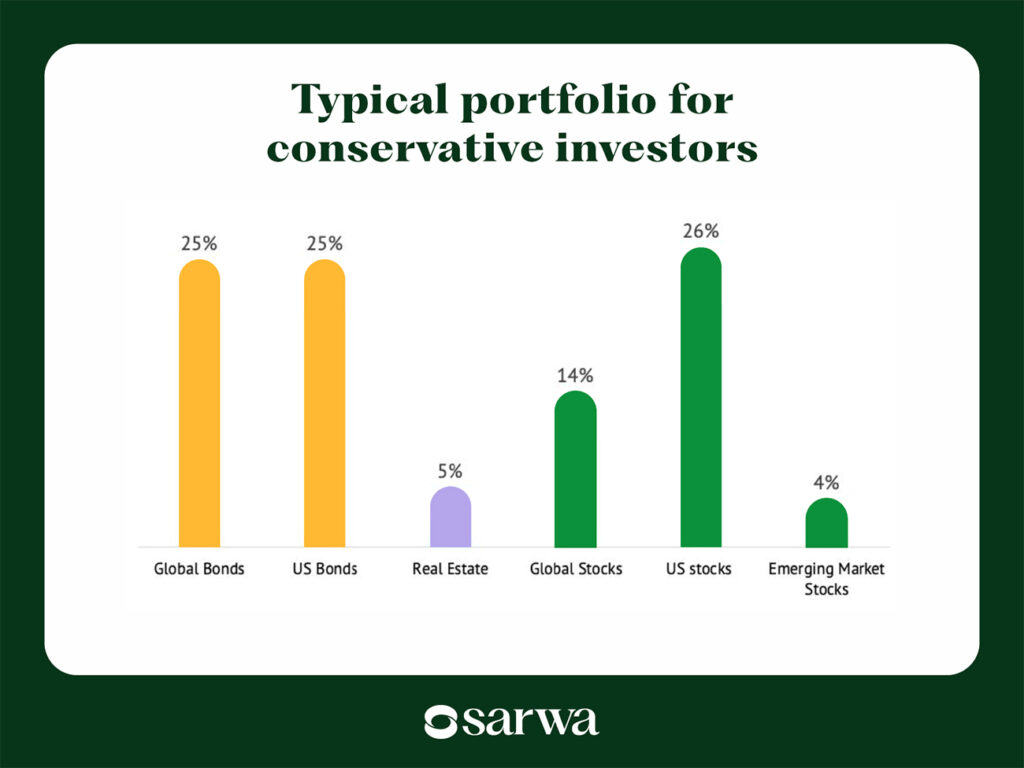
The key is to choose a portfolio structure based on your investment goals and current situation (time horizon). If you are closer to retirement, its advisable to have more bonds or bond funds. If you are young, you want more stocks or equity funds.
However, portfolio structure decisions do not have to be the equivalent of shooting in the dark. There are managed investment platforms (also known as wealth management platforms) that use technology and the latest insights in finance (such as the Modern Portfolio Theory) to create customized portfolios for clients.
Managed investment platforms are cost-effective, and they help you stay on course with your portfolio structure through periodic rebalancing.
Sarwa Invest is one such platform that helps investors grow their wealth by designing personalized portfolios of ETFs that match their time horizon, risk appetite (tolerance), risk capacity, and investment goals.
For example, the portfolio structure below was designed for conservative (risk-averse) investors:
Compare this with the portfolio structure they use for growth (growth-seeking) investors:
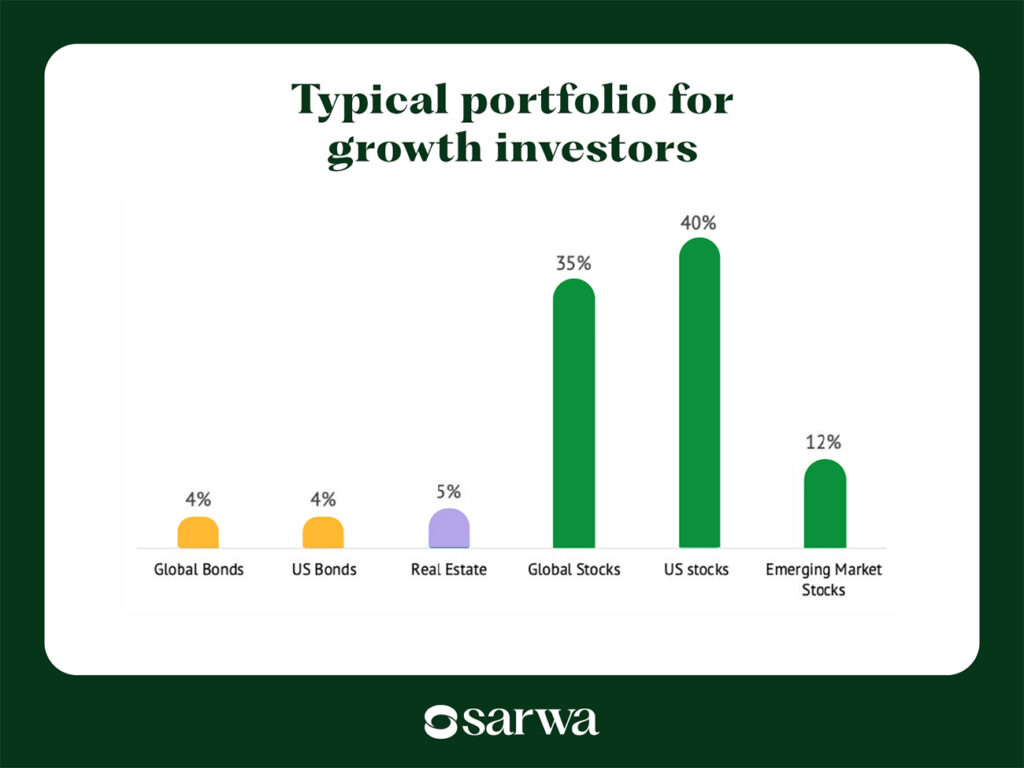
The difference in the above portfolios shows you how differences in investment goals and current situation affect your portfolio structure.
You can subscribe to a conventional Sarwa Invest portfolio for just $500. With us, you don’t need to be a high-net-worth individual to get personalized investment management.
However, it is worth stating that you don’t need to use a managed investment platform if you don’t want to.
If you have the time and skills to do fundamental and technical analysis, you can build an investment portfolio from scratch.
You can go the passive route by creating a portfolio of ETFs and designing a portfolio structure that matches your time horizon, investment goals, and risk tolerance. On the other hand, you can go the active route and build a diversified portfolio of individual assets.
If you choose to create your portfolio yourself, you can purchase all the assets we have talked about on the Sarwa app.
We provide access to more than 10,000 individual assets and ETFs across different asset classes. Transfers from your local bank account to your brokerage account are free. We also charge a low commission of $1 or 0.25% of traded value.
You can start your investment journey with as little as $500. We allow you to buy a fraction of a share of any asset if you can’t afford or don’t want to buy a single share. This makes it easy for you to diversify even with little capital.
4. Creating an investment plan
Given that this is an ultimate starter kit, we have covered so many grounds. By the time you are here, you might have forgotten some of the points we noted about how to invest your money.
To make it easier for you to remember the important details and act on them, we will conclude with practical steps you can take in the form of creating an investment plan.
Investing for beginners requires an investment plan, so you are not walking in the dark.
Below are the steps you should take to create a monthly investment plan in the UAE:
- Identify your goals and divide them by time period: For our purposes, you need to divide your goals into short-term, medium-term, and long-term.
This division is important because it is not advisable to keep money for short-to-medium term goals (buying a car, down payment for a house, paying a child’s school fees) in any of the UAE investment opportunities we have identified. While these assets can grow your money over the long term, they fluctuate in the short term.
Money for such goals is best placed in savings or fixed deposit accounts, where it is not exposed to market fluctuations. You can even earn higher interest with high-yield savings platforms like Sarwa Save.
- Allocate your monthly savings to your goals: If you have prepared a budget according to the 50/30/20 rule, then you are consistently saving 20% of your income every month. Your investment plan will outline how you intend to allocate this money to your short-term, medium-term, and long-term goals.
There is no magic formula here. The allocation formula will depend on your scale of preference.
- Create or select diversified portfolios for your long-term goals: For long-term goals, which is our concern, you need a diversified portfolio of the investment options in the UAE that we have discussed.
For many people, there is only one long-term goal: retirement. If you have more than one (inheritance for your children, for example), you can create multiple portfolios for each.
As we said, investing for beginners is easier if you allow a managed investment platform like Sarwa Invest to create such portfolios for you. But you can create your portfolios yourself if you have the time and skills.
- Automate deposits to your investment portfolios: We mentioned the importance of saving before spending. Sarwa Invest makes this easy. You can automate deposits from your salary account to your portfolios on Sarwa Invest. This will ensure that you are not tempted to overspend.
- Keep your portfolios efficient: Sarwa Invest will automatically rebalance your portfolios to make sure the efficient portfolio structure they have created remains intact after market movements have altered it.
Imagine having to do this yourself? This is another advantage of managed investment platforms.
Because of the rapid effects of compounding, the best time to start your investment journey is today.
Through our Sarwa Invest product, we can help you build an investment portfolio that best matches your personal profile and investment goals.
And if you have the time and skills to create your portfolio, you can purchase the assets we have discussed above on the Sarwa app.
Do you want to build wealth in the UAE? Sign up for Sarwa to create your investment portfolio or invest in a personalised and diversified portfolio of ETFs that matches your time horizon, risk tolerance, and risk capacity.
Takeaways
- Saving money is not enough; regular, long-term investing is the foundation of wealth creation.
- Before investing, get your finances in order by budgeting, sticking to your plan, and building an emergency fund.
- Focus on time-tested, safe investment options in the UAE, including stocks, bonds, ETFs, REITs, mutual funds, and gold, among others.
- Long-term investing and diversification are principles that will help you attain success in investing.